Partial Orders and Lattices questions

Q34

GATE CS 2024 CS-2Discrete MathematicsNAT1 mark
Let PP be the partial order defined on the set {1,2,3,4}\{1,2,3,4\} as follows
P={(x,x)∣x∈{1,2,3,4}}∪{(1,2),(3,2),(3,4)}P = \{(x, x) \mid x \in \{1,2,3,4\}\} \cup \{(1,2), (3,2), (3,4)\}
The number of total orders on {1,2,3,4}\{1,2,3,4\} that contain PP is __________
Show answer without attempting

Answer: 5

Q21

GATE CS 2017 CS-2Discrete MathematicsNAT1 mark
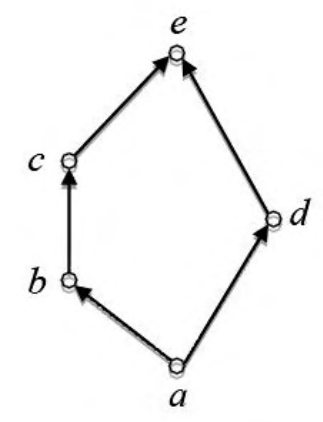
Consider the set X={a,b,c,d,e}X = \{a, b, c, d, e\} under the partial ordering
R={(a,a),(a,b),(a,c),(a,d),(a,e),(b,b),(b,c),(b,e),(c,c),(c,e),(d,d),(d,e),(e,e)}.R = \{(a,a), (a,b), (a,c), (a,d), (a,e), (b,b), (b,c), (b,e), (c,c), (c,e), (d,d), (d,e), (e,e)\}.
The Hasse diagram of the partial order (X,R)(X, R) is shown below.

The minimum number of ordered pairs that need to be added to RR to make (X,R)(X, R) a lattice is ____________.
Question figure
Show answer without attempting

Answer: -0.01 to 0.01

Q42

GATE CS 2015 CS-1Discrete MathematicsMCQ2 marks−2/3 if wrong
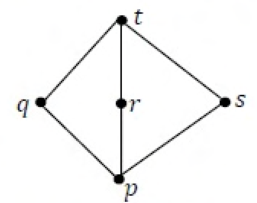
Suppose L={p,q,r,s,t}\mathcal{L} = \{p, q, r, s, t\} is a lattice represented by the following Hasse diagram:

For any x,y∈Lx, y \in \mathcal{L}, not necessarily distinct, x∨yx \vee y and x∧yx \wedge y are join and meet of x,yx, y, respectively. Let L3={(x,y,z):x,y,z∈L}\mathcal{L}^3 = \{(x, y, z) : x, y, z \in \mathcal{L}\} be the set of all ordered triplets of the elements of L\mathcal{L}. Let prp_r be the probability that an element (x,y,z)∈L3(x, y, z) \in \mathcal{L}^3 chosen equiprobably satisfies x∨(y∧z)=(x∨y)∧(x∨z)x \vee (y \wedge z) = (x \vee y) \wedge (x \vee z). Then
Question figure
Show answer without attempting

Answer: D

Q50

GATE CS 2014 CS-2Discrete MathematicsMCQ2 marks−2/3 if wrong
Consider the following relation on subsets of the set SS of integers between 1 and 2014. For two distinct subsets UU and VV of SS we say U<VU < V if the minimum element in the symmetric difference of the two sets is in UU.

Consider the following two statements:

S1S1: There is a subset of SS that is larger than every other subset.
S2S2: There is a subset of SS that is smaller than every other subset.

Which one of the following is CORRECT?
Show answer without attempting

Answer: A

0/40 correct0 marks

Related topics in Discrete Mathematics