Stacks questions

Q50

GATE CS 2026 CS-2Linear Data StructuresMSQ2 marks
Consider a stack SS and a queue QQ. Both of them are initially empty and have the capacity to store ten elements each. The elements 1, 2, 3, 4, and 5 arrive one by one, in that order. When an element arrives, it is assigned either to SS (pushed on SS) or to QQ (enqueued to QQ). Once all the five elements are stored, the output is generated in two steps. First, stack S is emptied by popping all elements. Then queue QQ is emptied by dequeueing all elements. The output obtained by following this process is 4  3  1  2  54 \; 3 \; 1 \; 2 \; 5.

Given the output, the objective is to predict whether an element was assigned to SS or QQ.

Which of the following options is/are possible valid assignment(s) of the elements?

Note: In the options, the notation xSxS denotes that element xx was assigned to SS and yQyQ denotes that element yy was assigned to QQ.
More than one option can be correct.
Show answer without attempting

Answer: A, B
Q45

GATE CS 2025 CS-2Linear Data StructuresMSQ2 marks
Consider a stack data structure into which we can PUSH and POP records. Assume that each record pushed in the stack has a positive integer key and that all keys are distinct.

We wish to augment the stack data structure with an O(1)O(1) time MIN operation that returns a pointer to the record with smallest key present in the stack
1) without deleting the corresponding record, and
2) without increasing the complexities of the standard stack operations.

Which one or more of the following approach(es) can achieve it?
More than one option can be correct.
Show answer without attempting

Answer: A

Q48

GATE CS 2024 CS-2Linear Data StructuresMSQ2 marks
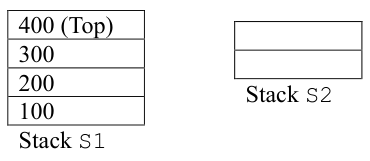
Let S1 and S2 be two stacks. S1 has capacity of 4 elements. S2 has capacity of 2 elements. S1 already has 4 elements: 100, 200, 300, and 400, whereas S2 is empty, as shown below.

Only the following three operations are available:
PushToS2: Pop the top element from S1 and push it on S2.
PushToS1: Pop the top element from S2 and push it on S1.
GenerateOutput: Pop the top element from S1 and output it to the user.

Note that the pop operation is not allowed on an empty stack and the push operation is not allowed on a full stack.

Which of the following output sequences can be generated by using the above operations?
Question figure
More than one option can be correct.
Show answer without attempting

Answer: B, C, D

Q59

GATE CS 2023 CSLinear Data StructuresNAT2 marks
Consider a sequence aa of elements a0=1,a1=5,a2=7,a3=8,a4=9a_0 = 1, a_1 = 5, a_2 = 7, a_3 = 8, a_4 = 9, and a5=2a_5 = 2. The following operations are performed on a stack SS and a queue QQ, both of which are initially empty.

I: push the elements of aa from a0a_0 to a5a_5 in that order into SS.
II: enqueue the elements of aa from a0a_0 to a5a_5 in that order into QQ.
III: pop an element from SS.
IV: dequeue an element from QQ.
V: pop an element from SS.
VI: dequeue an element from QQ.
VII: dequeue an element from QQ and push the same element into SS.
VIII: Repeat operation VII three times.
IX: pop an element from SS.
X: pop an element from SS.

The top element of SS after executing the above operations is ____________.
Show answer without attempting

Answer: 8

Q21

GATE CS 2021 CS-1Linear Data StructuresNAT1 mark
Consider the following sequence of operations on an empty stack.
push(54); push(52); pop(); push(55); push(62); s = pop();
Consider the following sequence of operations on an empty queue.
enqueue(21); enqueue(24); dequeue(); enqueue(28); enqueue(32); q = dequeue();
The value of s + q is ______.
Show answer without attempting

Answer: 86

Q41

GATE CS 2016 CS-1Linear Data StructuresNAT2 marks
Let Q denote a queue containing sixteen numbers and S be an empty stack. Head(Q) returns the element at the head of the queue Q without removing it from Q. Similarly Top(S) returns the element at the top of S without removing it from S. Consider the algorithm given below.
while Q is not Empty do
    if S is Empty OR Top(S) <= Head(Q) then
        x := Dequeue(Q);
        Push(S,x);
    else
        x := Pop(S);
        Enqueue(Q,x);
    end
end
The maximum possible number of iterations of the while loop in the algorithm is ________.
Show answer without attempting

Answer: 256.0

Q28

GATE CS 2015 CS-3Linear Data StructuresMCQ1 mark−1/3 if wrong
The result evaluating the postfix expression 10  5  +  60  6  /  ∗  8  −10 \; 5 \; + \; 60 \; 6 \; / \; * \; 8 \; - is
Show answer without attempting

Answer: C

Q52

GATE CS 2015 CS-2Linear Data StructuresNAT2 marks
Consider the C program below.
#include <stdio.h>
int *A, stkTop;

int stkFunc(int opcode, int val)
{
    static int size=0, stkTop=0;

    switch (opcode) {
        case -1: size = val; break;
        case  0: if (stkTop < size) A[stkTop++] = val; break;
        default: if (stkTop) return A[--stkTop];
    }
    return -1;
}

int main()
{
    int B[20]; A = B; stkTop = -1;

    stkFunc (-1, 10);
    stkFunc ( 0, 5);
    stkFunc ( 0, 10);
    printf ("%d\n", stkFunc(1, 0) + stkFunc(1, 0));
}
The value printed by the above program is ___________.
Show answer without attempting

Answer: 15

Q41

GATE CS 2014 CS-2Linear Data StructuresMCQ2 marks−2/3 if wrong
Suppose a stack implementation supports an instruction REVERSE, which reverses the order of elements on the stack, in addition to the PUSH and POP instructions. Which one of the following statements is TRUE with respect to this modified stack?
Show answer without attempting

Answer: C

0/90 correct0 marks

Related topics in Linear Data Structures