Finite Automata questions — page 1 of 2

Q26

GATE CS 2026 CS-1Regular LanguagesMSQ1 mark
Let M be a nondeterministic finite automaton (NFA) with 6 states over a finite alphabet.

Which of the following options CANNOT be the number of states in the minimal deterministic finite automaton (DFA) that is equivalent to MM?
More than one option can be correct.
Show answer without attempting

Answer: B, D
Q47

GATE CS 2026 CS-2Regular LanguagesMSQ2 marks
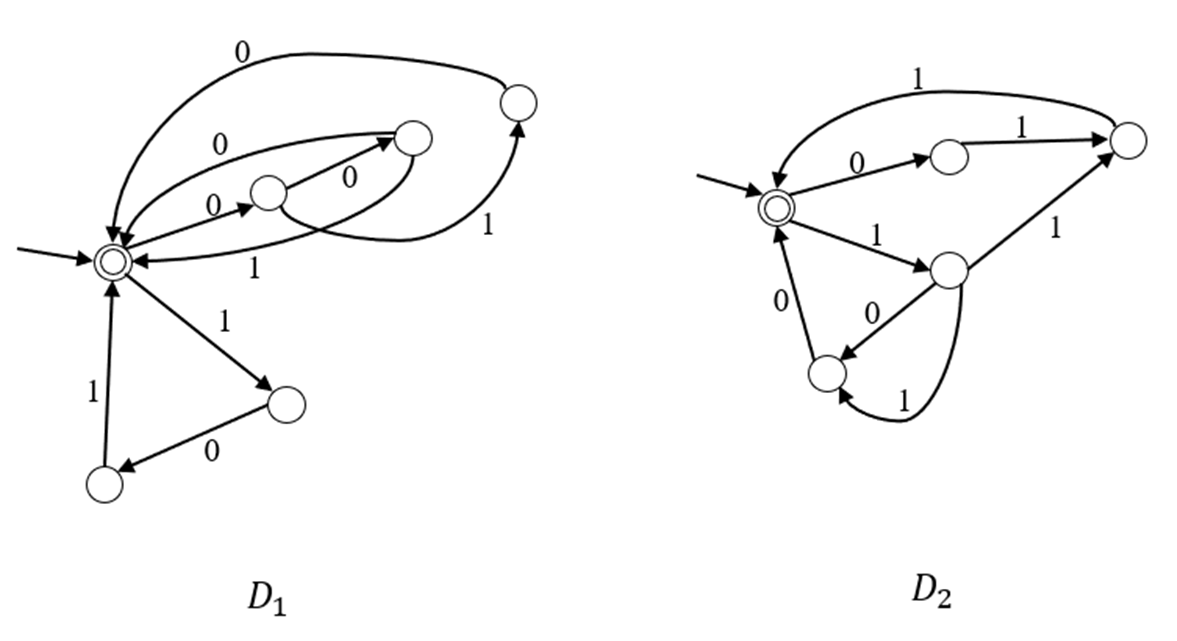
Consider the following two finite automata D1D_1 and D2D_2.

Which of the following statements is/are true?
Question figure
More than one option can be correct.
Show answer without attempting

Answer: C, D

Q28

GATE CS 2025 CS-1Regular LanguagesMSQ1 mark
A regular language LL is accepted by a non-deterministic finite automaton (NFA) with nn states. Which of the following statement(s) is/are FALSE?
More than one option can be correct.
Show answer without attempting

Answer: D

Q50

GATE CS 2025 CS-1Regular LanguagesMSQ2 marks
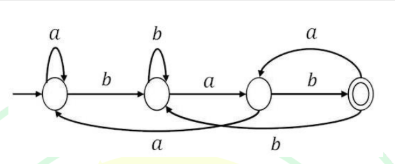
Consider the following deterministic finite automaton (DFA) defined over the alphabet, Σ={a,b}\Sigma = \{a, b\}. Identify which of the following language(s) is/are accepted by the given DFA.
Question figure
More than one option can be correct.
Show answer without attempting

Answer: C

Q59

GATE CS 2025 CS-1Regular LanguagesNAT2 marks
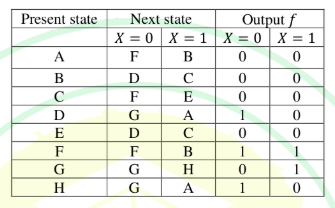
Consider a finite state machine (FSM) with one input XX and one output ff, represented by the given state transition table. The minimum number of states required to realize this FSM is ________. (Answer in integer)
Question figure
Show answer without attempting

Answer: 5

Q60

GATE CS 2025 CS-2Regular LanguagesNAT2 marks
Let Σ={1,2,3,4}\Sigma = \{1,2,3,4\}. For x∈Σ∗x \in \Sigma^*, let prod(x)prod(x) be the product of symbols in xx modulo 7. We take prod(ϵ)=1prod(\epsilon) = 1, where ϵ\epsilon is the null string.

For example, prod(124)=(1×2×4)(mod7)=1prod(124) = (1 \times 2 \times 4) \pmod 7 = 1.

Define L={x∈Σ∗∣prod(x)=2}L = \{x \in \Sigma^* \mid prod(x) = 2\}.

The number of states in a minimum state DFA for LL is ___________. (Answer in integer)
Show answer without attempting

Answer: 6

Q50

GATE CS 2024 CS-1Regular LanguagesMSQ2 marks
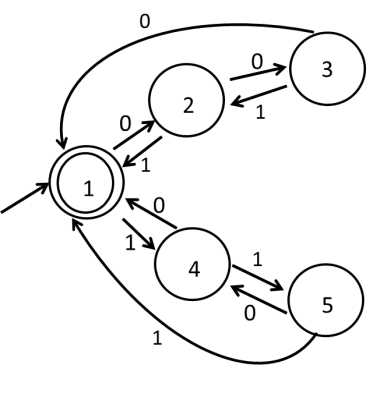
Consider the 5-state DFA MM accepting the language L(M)⊂(0+1)∗L(M) \subset (0 + 1)^* shown below. For any string w∈(0+1)∗w \in (0 + 1)^* let n0(w)n_0(w) be the number of 0′s0's in ww and n1(w)n_1(w) be the number of 1′s1's in ww.
Which of the following statements is/are FALSE?
Question figure
More than one option can be correct.
Show answer without attempting

Answer: B, C

Q63

GATE CS 2023 CSRegular LanguagesNAT2 marks
Consider the language LL over the alphabet {0,1}\{0, 1\}, given below:
L={w∈{0,1}∗∣w does not contain three or more consecutive 1’s}.L = \{w \in \{0, 1\}^* \mid w \text{ does not contain three or more consecutive 1's}\}.
The minimum number of states in a Deterministic Finite-State Automaton (DFA) for LL is ____________.
Show answer without attempting

Answer: 4

Q38

GATE CS 2021 CS-1Regular LanguagesMCQ2 marks−2/3 if wrong
Consider the following language.
L={w∈{0,1}∗∣w ends with the substring 011}L = \{w \in \{0, 1\}^* \mid w \text{ ends with the substring } 011\}
Which one of the following deterministic finite automata accepts LL?
Show answer without attempting

Answer: D

Q9

GATE CS 2021 CS-2Regular LanguagesMCQ1 mark−1/3 if wrong
Let L⊆{0,1}∗L \subseteq \{0,1\}^* be an arbitrary regular language accepted by a minimal DFA with kk states. Which one of the following languages must necessarily be accepted by a minimal DFA with kk states?
Show answer without attempting

Answer: C

Q17

GATE CS 2021 CS-2Regular LanguagesNAT1 mark
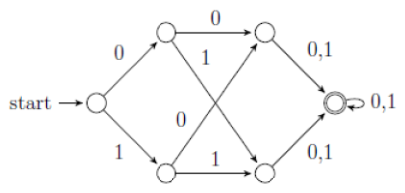
Consider the following deterministic finite automaton (DFA).

The number of strings of length 8 accepted by the above automaton is ____________.
Question figure
Show answer without attempting

Answer: 256

Q51

GATE CS 2020 CSRegular LanguagesNAT2 marks
Consider the following language.

L={x∈{a,b}∗∣number of a’s in x is divisible by 2 but not divisible by 3}L = \{x \in \{a, b\}^* \mid \text{number of } a\text{'s in } x \text{ is divisible by 2 but not divisible by 3}\}

The minimum number of states in a DFA that accepts LL is __________.
Show answer without attempting

Answer: 6

Q48

GATE CS 2019 CSRegular LanguagesNAT2 marks
Let Σ\Sigma be the set of all bijections from {1,...,5}\{1, ..., 5\} to {1,...,5}\{1, ..., 5\}, where idid denotes the identity function, i.e. id(j)=j,∀jid(j) = j, \forall j. Let ∘\circ denote composition on functions. For a string x=x1x2⋯xn∈Σn,n≥0x = x_1 x_2 \cdots x_n \in \Sigma^n, n \ge 0, let π(x)=x1∘x2∘⋯∘xn\pi(x) = x_1 \circ x_2 \circ \cdots \circ x_n.
Consider the language L={x∈Σ∗∣π(x)=id}L = \{x \in \Sigma^* \mid \pi(x) = id\}. The minimum number of states in any DFA accepting LL is __________.
Show answer without attempting

Answer: 120

Q6

GATE CS 2018 CSRegular LanguagesMCQ1 mark−1/3 if wrong
Let N be an NFA with nn states. Let kk be the number of states of a minimal DFA which is equivalent to N. Which one of the following is necessarily true?
Show answer without attempting

Answer: D

Q52

GATE CS 2018 CSRegular LanguagesNAT2 marks
Given a language LL, define LiL^i as follows:

L0={ε}L^0 = \{\varepsilon\}
Li=Li−1⋅L for all i>0L^i = L^{i-1} \cdot L \text{ for all } i > 0

The order of a language LL is defined as the smallest kk such that Lk=Lk+1L^k = L^{k+1}.
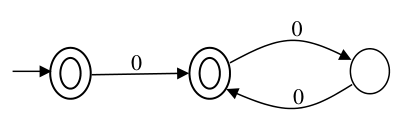
Consider the language L1L_1 (over alphabet 0) accepted by the following automaton.

The order of L1L_1 is _____.
Question figure
Show answer without attempting

Answer: 2

Q22

GATE CS 2017 CS-1Regular LanguagesNAT1 mark
Consider the language LL given by the regular expression (a+b)∗b(a+b)(a+b)^*b(a+b) over the alphabet {a,b}\{a, b\}. The smallest number of states needed in a deterministic finite-state automaton (DFA) accepting LL is ____________.
Show answer without attempting

Answer: 4.0

Q25

GATE CS 2017 CS-2Regular LanguagesNAT1 mark
The minimum possible number of states of a deterministic finite automaton that accepts the regular language L={w1aw2∣w1,w2∈{a,b}∗,∣w1∣=2,∣w2∣≥3}L = \{w_1 a w_2 \mid w_1, w_2 \in \{a, b\}^*, \lvert w_1 \rvert = 2, \lvert w_2 \rvert \ge 3\} is ____________.
Show answer without attempting

Answer: 8.0

Q39

GATE CS 2017 CS-2Regular LanguagesMCQ2 marks−2/3 if wrong
Let δ\delta denote the transition function and δ^\widehat{\delta} denote the extended transition function of the ϵ\epsilon-NFA whose transition table is given below:
δ\deltaϵ\epsilonaabb
→q0\rightarrow q_0{q2}\{q_2\}{q1}\{q_1\}{q0}\{q_0\}
q1q_1{q2}\{q_2\}{q2}\{q_2\}{q3}\{q_3\}
q2q_2{q0}\{q_0\}∅\emptyset∅\emptyset
q3q_3∅\emptyset∅\emptyset{q2}\{q_2\}
Then δ^(q2,aba)\widehat{\delta}(q_2, aba) is
Show answer without attempting

Answer: C

Q16

GATE CS 2016 CS-2Regular LanguagesNAT1 mark
The number of states in the minimum sized DFA that accepts the language defined by the regular expression
(0+1)∗(0+1)(0+1)∗(0+1)^*(0+1)(0+1)^*
is _________.
Show answer without attempting

Answer: 2.0

Q42

GATE CS 2016 CS-2Regular LanguagesMCQ2 marks−2/3 if wrong
Consider the following two statements:

I. If all states of an NFA are accepting states then the language accepted by the NFA is Σ∗\Sigma^*.
II. There exists a regular language AA such that for all languages BB, A∩BA \cap B is regular.

Which one of the following is CORRECT?
Show answer without attempting

Answer: B

0/200 correct0 marks

Related topics in Regular Languages