General Science questions

Q.141

12 Dec 2025 Shift 2
When barium chloride reacts with aluminium sulphate, it gives aluminium chloride along with:
Show answer without attempting

Answer: A — a white colour precipitate of barium sulphate

When barium chloride (BaCl_2) reacts with aluminium sulphate (Al_2(SO_4)_3), a double displacement reaction takes place, producing aluminium chloride and a thick white precipitate of barium sulphate (BaSO_4).
Open question page

Q.142

12 Dec 2025 Shift 2
Why do we need to conserve coal and petroleum?
Show answer without attempting

Answer: B — They are non-renewable sources of energy.

Coal and petroleum are fossil fuels formed over millions of years from dead organic matter. Their reserves are limited and cannot be quickly replenished once exhausted, making them non-renewable sources that need conservation.

Open question page

Q.143

12 Dec 2025 Shift 2
The absolute refractive index of a medium is defined as the ratio of ___________.
Show answer without attempting

Answer: A — speed of light in vacuum to speed of light in medium

The absolute refractive index (n) of a medium is defined as the ratio of the speed of light in vacuum (c) to the speed of light in that medium (v), expressed as n = c/v.

Open question page

Q.144

12 Dec 2025 Shift 2
A government scheme promotes the rearing of fish in artificially controlled freshwater ponds. What is this type of fishing called?
Show answer without attempting

Answer: D — Culture fishing

Culture fishing refers to the cultivation and rearing of fish in artificially controlled water bodies like ponds, tanks, or reservoirs, as opposed to capture fishing which involves catching fish from natural water resources.

Open question page

Q.145

12 Dec 2025 Shift 2
A boy is running in a circular track of radius 10 m. He completes one circle in 1 minute. What is his average speed?
Show answer without attempting

Answer: B — 1.04 m/s

Average speed is total distance divided by total time. The distance of one circular track is the circumference C = 2 π r = 2 × 22/7 × 10 = 440/7 ≈ 62.86 m. Time = 1 minute = 60 s. Average speed = 62.86/60 ≈ 1.04 m/s.

Open question page

Q.146

12 Dec 2025 Shift 2
Which of the following cell organelles is filled with digestive enzymes and helps to keep the cell clean by digesting any foreign material as well as worn out cell organelles?
Show answer without attempting

Answer: B — Lysosomes

Lysosomes are membrane-bound organelles containing powerful digestive enzymes. They serve as the waste disposal system of the cell by digesting foreign materials and damaged cell organelles, earning them the name 'suicide bags'.

Open question page

Q.147

12 Dec 2025 Shift 2
How many atoms are there in a molecule of water?
Show answer without attempting

Answer: B — 3

A molecule of water has the chemical formula H_2O, which consists of 2 hydrogen atoms and 1 oxygen atom, making a total of 3 atoms.

Open question page

Q.148

12 Dec 2025 Shift 2
Isobars are atoms having the same:
Show answer without attempting

Answer: B — mass number, different elements

Isobars are atoms of different chemical elements that have the same mass number (sum of protons and neutrons) but different atomic numbers (number of protons).

Open question page

Q.149

12 Dec 2025 Shift 2
A voltmeter is always connected in a circuit:
Show answer without attempting

Answer: B — in parallel

A voltmeter measures the potential difference between two points in a circuit. To measure the exact potential difference across a component without drawing significant current, it must always be connected in parallel across that component.

Open question page

Q.150

12 Dec 2025 Shift 2
According to Joule’s law of heating, the heat produced (H) is directly proportional to which of the following?
Show answer without attempting

Answer: B — The square of the current (I^2)

According to Joule's law of heating, the heat produced in a resistor is given by H = I^2Rt. Therefore, the heat (H) is directly proportional to the square of the current (I^2), resistance (R), and time (t).

Open question page

Q.151

12 Dec 2025 Shift 3
Which type of epithelial tissue is found lining the kidney tubules?
Show answer without attempting

Answer: C — Cuboidal Epithelium

Cuboidal epithelium lines the kidney tubules and ducts of salivary glands, where it provides mechanical support and helps in secretion and absorption. Columnar epithelium is found in the lining of the stomach and intestines.

Open question page

Q.152

12 Dec 2025 Shift 3
The bad taste or smell from the leftover food is caused due to:
Show answer without attempting

Answer: B — the oxidation of fats and oil

When foods containing fats and oils are left exposed for a long time, they get oxidized and become rancid, which changes their smell and taste. This process is known as rancidification.

Open question page

Q.153

12 Dec 2025 Shift 3
Which of the following is correct if the egg is NOT fertilised with the sperm?
Show answer without attempting

Answer: C — Uterus lining slowly breaks, sheds as blood and mucous

If the egg is not fertilised, the thick and spongy lining of the uterus, which was prepared to receive a fertilized egg, is no longer needed. Hence, it slowly breaks and sheds along with blood vessels and mucous through the vagina, a process known as menstruation.

Open question page

Q.154

12 Dec 2025 Shift 3
Which of the following particles contribute to the mass number?
Show answer without attempting

Answer: B — Protons and Neutrons

The mass number of an atom is defined as the total number of protons and neutrons (collectively called nucleons) present in the nucleus of an atom. Electrons have negligible mass compared to nucleons and are not counted.

Open question page

Q.155

12 Dec 2025 Shift 3
Budding in Hydra is best classified as:
Show answer without attempting

Answer: C — asexual reproduction

Budding is a type of asexual reproduction where a new organism develops from an outgrowth or bud due to cell division at one particular site, as commonly seen in Hydra.

Open question page

Q.156

12 Dec 2025 Shift 3
According to the sign convention for lenses, all distances measured in the direction of incident light are taken as:
Show answer without attempting

Answer: B — positive

According to the Cartesian sign convention for lenses and mirrors, all distances measured along the direction of incident light (to the right of the optical center) are taken as positive, while those opposite to the direction of incident light are negative.

Open question page

Q.157

12 Dec 2025 Shift 3
Which of the following is NOT the use of bleaching powder?
Show answer without attempting

Answer: B — for removing permanent hardness of water

Bleaching powder (calcium oxychloride, CaOCl2) is used for disinfecting drinking water, bleaching in textile industries, and as an oxidizing agent. Permanent hardness of water is removed using washing soda (sodium carbonate), not bleaching powder.

Open question page

Q.158

12 Dec 2025 Shift 3
Which of the following metals forms a protective oxide layer on its surface when exposed to air, preventing further corrosion?
Show answer without attempting

Answer: B — Aluminium

Aluminium reacts with oxygen in the air to form a thin, stable, and protective layer of aluminium oxide (Al2O3) on its surface. This passive layer prevents further underlying corrosion.

Open question page

Q.159

12 Dec 2025 Shift 3
In liquids, a small fraction of particles at the surface, having higher kinetic energy, which is able to break away from the forces of attraction of other particles, will ultimately get converted into which state?
Show answer without attempting

Answer: C — Vapor

Evaporation is a surface phenomenon where liquid particles at the surface with higher kinetic energy overcome intermolecular forces of attraction and escape directly into the vapor (or gas) state.

Open question page

Q.160

12 Dec 2025 Shift 3
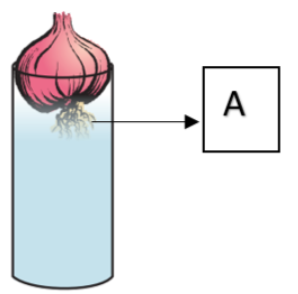
Study the experimental set up containing a water filled jar and an onion with growing roots set vertically up. Which type of tissue is present in the portion A of roots tips?
Question figure
Show answer without attempting

Answer: B — Meristematic tissue

The tip of the root (region A) contains actively dividing cells responsible for the growth in length of the plant. This tissue is known as meristematic tissue.

Open question page

Related topics in RRB Group D

0/200 correct0 marks