Filter by year

Classification / Odd One Out questions

Q.61

12 Sep 2024 Shift 1
Based on the English alphabetical order, three of the following four letter-clusters are alike in a certain way and thus form a group. Which is the one that DOES NOT belong to that group? (Note: The odd man out is not based on the number of consonants/vowels or their position in the letter-cluster.)
Show answer without attempting

Answer: D — KJE

Open question page
Q.62

12 Sep 2024 Shift 2
Based on the English alphabetical order, three of the following four letter-clusters are alike in a certain way and thus form a group. Which is the letter-cluster that DOES NOT belong to that group? (Note: The odd man out is not based on the number of consonants/vowels or their position in the letter-cluster.)
Show answer without attempting

Answer: C — ACG

Open question page

Q.63

12 Sep 2024 Shift 2
Three of the following numbers are alike in a certain way and one is different. Pick the odd one out. (NOTE : Operations should be performed on the whole numbers, without breaking down the numbers into its constituent digits. E.g. 13 – Operations on 13 such as adding /deleting /multiplying etc., to 13 can be performed. Breaking down 13 into 1 and 3 and then performing mathematical operations on 1 and 3 is not allowed.)
Show answer without attempting

Answer: C — 23 – 8 – 343

Open question page

Q.64

12 Sep 2024 Shift 3
Three of the following four are alike in a certain way and thus form a group. Which is the one that does NOT belong to that group? The odd one out is not based on the number of consonants/vowels or their position in the letter cluster
Show answer without attempting

Answer: D — LQS

Open question page

Q.65

12 Sep 2024 Shift 3
Three of the following number-pairs are alike in some manner and hence form a group. Which number-pair does not belong to that group? (NOTE: Operations should be performed on the whole numbers, without breaking down the numbers into its constituent digits. E.g. 13 – Operations on 13 such as adding/subtracting/multiplying etc. to 13 can be performed. Breaking down 13 into 1 and 3 and then performing mathematical operations on 1 and 3 is not allowed.)
Show answer without attempting

Answer: A — 14 – 121

Open question page

Q.66

11 Sep 2024 Shift 1
The question contains pairs of words that are related to each other in a certain way. Three of the following four word pairs are alike as these have the same relationship and thus form a group. Which word pair is the one that DOES NOT belong to that group? (The words must be considered as meaningful English words and must not be related to each other based on the number of letters / number of consonants/vowels in the word.)
Show answer without attempting

Answer: D — Uterus – urologist

Open question page

Q.67

11 Sep 2024 Shift 1
The same operation(s) are followed in all the given number pairs except one. Find that odd number pair. (NOTE : Operations should be performed on the whole numbers, without breaking down the numbers into its constituent digits. E.g. 13 – Operations on 13 such as adding /deleting /multiplying etc., to 13 can be performed. Breaking down 13 into 1 and 3 and then performing mathematical operations on 1 and 3 is not allowed.)
Show answer without attempting

Answer: C — 128 : 16

Open question page

Q.68

11 Sep 2024 Shift 2
The position of how many letters will remain unchanged if each of the letters in the word ‘JEALOUS’ is arranged in the English alphabetical order?
Show answer without attempting

Answer: D — Three

Open question page

Q.69

11 Sep 2024 Shift 2
Four letter-clusters have been given out of which three are alike in some manner and one is different. Select the one that is different. Note: The odd one out is not based on the number of consonants/vowels or their position in the letter cluster
Show answer without attempting

Answer: C — LKP

Open question page

Q.70

11 Sep 2024 Shift 2
Three of the following numbers are alike in a certain way and one is different. Pick the odd one out. (NOTE : Operations should be performed on the whole numbers, without breaking down the numbers into its constituent digits. E.g. 13 – Operations on 13 such as adding /deleting /multiplying etc., to 13 can be performed. Breaking down 13 into 1 and 3 and then performing mathematical operations on 1 and 3 is not allowed.)
Show answer without attempting

Answer: D — 45 – 70

Open question page

Q.71

11 Sep 2024 Shift 3
Four letter-clusters have been given, out of which three are alike in some manner and one is different. Select the one that is different. Note : The odd one out is not based on the number of consonants/vowels or their position in the letter cluster
Show answer without attempting

Answer: A — ONM

Open question page

Q.72

10 Sep 2024 Shift 1
Four letter-clusters have been given, out of which three are alike in some manner and one is different. Select the one that is different. The odd one out is not based on the number of consonants/vowels or their position in the letter cluster
Show answer without attempting

Answer: C — PTX

Open question page

Q.73

10 Sep 2024 Shift 1
Three of the following four options are alike in a certain way and thus form a group. Which is the option that does NOT belong to that group? (NOTE : Operations should be performed on the whole numbers, without breaking down the numbers into its constituent digits. E.g. 13 – Operations on 13 such as adding /deleting /multiplying etc., to 13 can be performed. Breaking down 13 into 1 and 3 and then performing mathematical operations on 1 and 3 is not allowed).
Show answer without attempting

Answer: D — 3 – 2 – 5

Open question page

Q.74

10 Sep 2024 Shift 2
Three of the following number-pairs are alike in some manner and hence form a group. Which number-pair does not belong to that group? (NOTE: Operations should be performed on the whole numbers, without breaking down the numbers into its constituent digits. E.g. 13 – Operations on 13 such as adding/subtracting/multiplying etc. to 13 can be performed. Breaking down 13 into 1 and 3 and then performing mathematical operations on 1 and 3 is not allowed.)
Show answer without attempting

Answer: A — 15 – 240

Open question page

Q.75

10 Sep 2024 Shift 2
Three of the following four are alike in a certain way and thus form a group. Which is the one that does NOT belong to that group? The odd one out is not based on the number of consonants/vowels or their position in the letter cluster
Show answer without attempting

Answer: A — DHK

Open question page

Q.76

10 Sep 2024 Shift 3
Three of the following four options are alike in a certain way and thus form a group. Which is the one that does NOT belong to that group? (NOTE: Operations should be performed on the whole numbers, without breaking down the numbers into its constituent digits. E.g. 13 – Operations on 13 such as adding/subtracting/multiplying etc. to 13 can be performed. Breaking down 13 into 1 and 3 and then performing mathematical operations on 1 and 3 is not allowed.)
Show answer without attempting

Answer: B — 52 – 68 – 51

Open question page

Q.77

10 Sep 2024 Shift 3
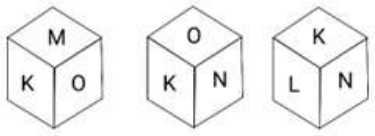
Six letters K, L, M, N, O and P are written on different faces of a dice. Three positions of this dice are shown in the figure. Find the letter on the face opposite to M.
Question figure
Show answer without attempting

Answer: D — N

Open question page

Q.78

10 Sep 2024 Shift 3
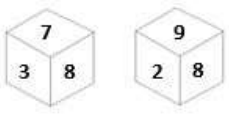
Two different positions of the same dice with faces 3, 7, 8, 2, 9 and 4 are shown below. Select the number that will be on the face opposite to the one having 4.
Question figure
Show answer without attempting

Answer: C — 8

Open question page

Q.79

10 Sep 2024 Shift 3
Three of the following four are alike in a certain way and thus form a group. Which is the one that does NOT belong to that group? ( Note :The odd one out is not based on the number of consonants/vowels or their position in the letter cluster)
Show answer without attempting

Answer: B — DIM

Open question page

Q.80

9 Sep 2024 Shift 1
In the following number-pairs, the second number is obtained by applying certain mathematical operations to the first number. In three of the four pairs, the same pattern is applied and hence they form a group. Select the number-pair that DOES NOT belong to this group. (NOTE: Operations should be performed on the whole numbers, without breaking down the numbers into their constituent digits. E.g. 13 – Operations on 13 such as adding/subtracting/multiplying to 13 can be performed. Breaking down 13 into 1 and 3 and then performing mathematical operations on 1 and 3 is not allowed.)
Show answer without attempting

Answer: B — 358 - 152

Open question page

Related topics in Verbal Reasoning

0/200 correct0 marks