General Intelligence & Reasoning questions

Q.661

12 Sep 2024 Shift 3
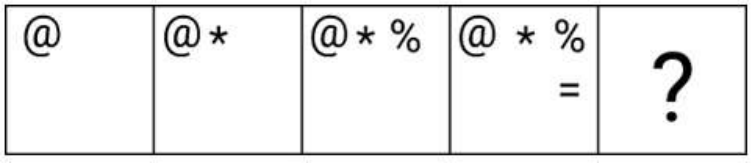
Three of the following four are alike in a certain way and thus form a group. Which is the one that does NOT belong to that group? The odd one out is not based on the number of consonants/vowels or their position in the letter cluster
Show answer without attempting

Answer: D — LQS

Open question page
Q.662

12 Sep 2024 Shift 3
All of the letters in the word ‘FROWNED’ are arranged in alphabetical order. How many letters are there in the English alphabetical series between the letter which is fourth from the left end and the one which is second from the right end in the new letter-cluster thus formed?
Show answer without attempting

Answer: C — Three

Open question page

Q.664

12 Sep 2024 Shift 3
Select the option that is related to the fifth letter-cluster in the same way as the second letter-cluster is related to the first letter-cluster and the fourth letter-cluster is related to the third letter-cluster. FISH : DKQJ :: POND : NQLF :: SIZE : ?
Show answer without attempting

Answer: D — QKXG

Open question page

Q.665

12 Sep 2024 Shift 3
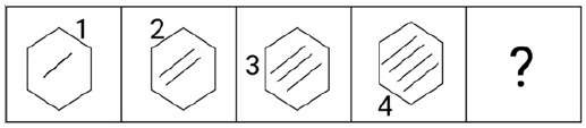
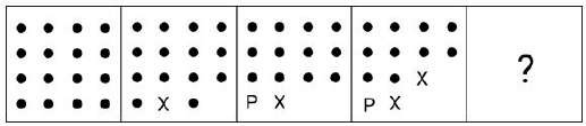
Identify the figure from among the given options which when put in place of the question mark (?) will logically complete the series.
Question figure
Show answer without attempting

Answer: C —

Open question page

Q.666

12 Sep 2024 Shift 3
Three of the following number-pairs are alike in some manner and hence form a group. Which number-pair does not belong to that group? (NOTE: Operations should be performed on the whole numbers, without breaking down the numbers into its constituent digits. E.g. 13 – Operations on 13 such as adding/subtracting/multiplying etc. to 13 can be performed. Breaking down 13 into 1 and 3 and then performing mathematical operations on 1 and 3 is not allowed.)
Show answer without attempting

Answer: A — 14 – 121

Open question page

Q.667

12 Sep 2024 Shift 3
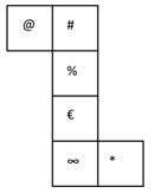
A cube is constructed by folding the given sheet along the lines shown. In the cube so formed, what would be the symbol on the opposite side of ‘#’?
Question figure
Show answer without attempting

Answer: C — €

Open question page

Q.668

12 Sep 2024 Shift 3
Select the option that represents the letters which, when sequentially placed from left to right in the blanks below, will complete the letter series. f d _ e _ e f _ d d _ d _ f f _ d _ d _ f
Show answer without attempting

Answer: D — d d f e e d e e

Open question page

Q.669

12 Sep 2024 Shift 3
Select the set in which the numbers are related in the same way as are the numbers of the following set. 3 — 5 — 30 2 — 4 — 16 (NOTE: Operations should be performed on the whole numbers, without breaking down the numbers into its constituent digits. E.g. 13 – Operations on 13 such as adding/subtracting/multiplying etc. to 13 can be performed. Breaking down 13 into 1 and 3 and then performing mathematical operations on 1 and 3 is not allowed)
Show answer without attempting

Answer: B — 6 — 6 — 72

Open question page

Q.670

12 Sep 2024 Shift 3
In a certain code language, ‘A + B’ means ‘A is the mother of B’; ‘A – B’ means ‘A is the husband of B’; ‘A × B’ means ‘A is the father of B’ and ‘A ÷ B’ means ‘A is the daughter of B’. Based on the above, how is K related to O if ‘K ÷ L − M + N × O’?
Show answer without attempting

Answer: B — Father’s sister

Open question page

Q.671

12 Sep 2024 Shift 3
Select the set in which the numbers are related in the same way as are the numbers of the following set. (34, 17, 27) (42, 21, 31) (NOTE: Operations should be performed on the whole numbers, without breaking down the numbers into its constituent digits. E.g. 13 – Operations on 13 such as adding/deleting/multiplying etc. to 13 can be performed. Breaking down 13 into 1 and 3 and then performing mathematical operations on 1 and 3 is not allowed.)
Show answer without attempting

Answer: B — (54, 27, 37)

Open question page

Q.672

12 Sep 2024 Shift 3
44 is related to 1936 by certain logic. Following the same logic, 59 is related to 3481. To which of the following is 77 related, following the same logic? (NOTE : Operations should be performed on the whole numbers, without breaking down the numbers into its constituent digits. E.g. 13 – Operations on 13 such as adding /deleting /multiplying etc., to 13 can be performed. Breaking down 13 into 1 and 3 and then performing mathematical operations on 1 and 3 is not allowed.)
Show answer without attempting

Answer: B — 5929

Open question page

Q.673

12 Sep 2024 Shift 3
Which of the following numbers will replace the question mark (?) in the given series? 7, 13, ?, 145, 721, 4321
Show answer without attempting

Answer: D — 37

Open question page

Q.675

12 Sep 2024 Shift 3
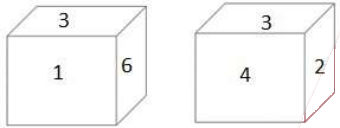
Two different positions of the same dice are given below. Which is the number on the face opposite the face containing 5?
Question figure
Show answer without attempting

Answer: B — 3

Open question page

Q.676

11 Sep 2024 Shift 1
Which two numbers (not digits) should be interchanged to make the given equation correct? 48÷3+12×4–6×7+21=2748 \div 3 + 12 \times 4 – 6 \times 7 + 21 = 27
Show answer without attempting

Answer: C — 3 and 4

Open question page

Q.677

11 Sep 2024 Shift 1
In the following number-pairs, the second number is obtained by applying certain mathematical operations to the first number. Select the set in which the numbers are related in the same way as are the numbers of the following sets. (NOTE : Operations should be performed on the whole numbers, without breaking down the numbers into its constituent digits. E.g. 13 – Operations on 13 such as adding /deleting /multiplying etc., to 13 can be performed. Breaking down 13 into 1 and 3 and then performing mathematical operations on 1 and 3 is not allowed.) (280,140)(280, 140) (186,93)(186, 93)
Show answer without attempting

Answer: D — (118, 59)

Open question page

Q.679

11 Sep 2024 Shift 1
Three statements are given, followed by three conclusions numbered I, II and III. Assuming the statements to be true, even if they seem to be at variance with commonly known facts, decide which of the conclusions logically follow(s) from the statements. Statements: All bottles are jugs. Some bottles are flasks. All flasks are bins. Conclusions: I. Some bottles are bins. II. Some jugs are bins. III. Some flasks are jugs.
Show answer without attempting

Answer: A — All conclusions I, II and III follow

Open question page

Related topics in SSC CGL

0/200 correct0 marks