Searching Sorting and Hashing questions

Q2

GATE CS 2021 CS-1Searching Sorting and HashingMCQ1 mark−1/3 if wrong
Let P be an array containing nn integers. Let tt be the lowest upper bound on the number of comparisons of the array elements, required to find the minimum and maximum values in an arbitrary array of nn elements. Which one of the following choices is correct?
Show answer without attempting

Answer: C
Q9

GATE CS 2021 CS-1Searching Sorting and HashingMCQ1 mark−1/3 if wrong
Consider the following array.
2332456972738997
Which algorithm out of the following options uses the least number of comparisons (among the array elements) to sort the above array in ascending order?
Show answer without attempting

Answer: C

Q47

GATE CS 2021 CS-1Searching Sorting and HashingMSQ2 marks
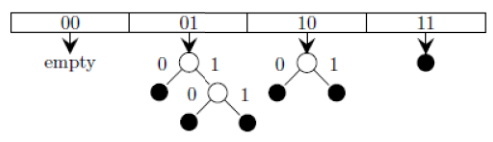
Consider a dynamic hashing approach for 4-bit integer keys:
1. There is a main hash table of size 4.
2. The 2 least significant bits of a key is used to index into the main hash table.
3. Initially, the main hash table entries are empty.
4. Thereafter, when more keys are hashed into it, to resolve collisions, the set of all keys corresponding to a main hash table entry is organized as a binary tree that grows on demand.
5. First, the 3rd least significant bit is used to divide the keys into left and right subtrees.
6. To resolve more collisions, each node of the binary tree is further sub-divided into left and right subtrees based on the 4th least significant bit.
7. A split is done only if it is needed, i.e., only when there is a collision.
Consider the following state of the hash table.
Which of the following sequences of key insertions can cause the above state of the hash table (assume the keys are in decimal notation)?
Question figure
More than one option can be correct.
Show answer without attempting

Answer: C

0/30 correct0 marks

Related topics in Algorithms