Intermediate Code Generation questions

Q39

GATE CS 2024 CS-1Intermediate CodeMCQ2 marks−2/3 if wrong
Consider the following pseudo-code.
L1:t1=−1L1: t1 = -1
L2:t2=0L2: t2 = 0
L3:t3=0L3: t3 = 0
L4:t4=4∗t3L4: t4 = 4 * t3
L5:t5=4∗t2L5: t5 = 4 * t2
L6:t6=t5∗ML6: t6 = t5 * M
L7:t7=t4+t6L7: t7 = t4 + t6
L8:t8=a[t7]L8: t8 = a[t7]
L9:if t8<=max goto L11L9: \text{if } t8 <= max \text{ goto } L11
L10:t1=t8L10: t1 = t8
L11:t3=t3+1L11: t3 = t3 + 1
L12:if t3<M goto L4L12: \text{if } t3 < M \text{ goto } L4
L13:t2=t2+1L13: t2 = t2 + 1
L14:if t2<N goto L3L14: \text{if } t2 < N \text{ goto } L3
L15:max=t1L15: max = t1
Which one of the following options CORRECTLY specifies the number of basic blocks and the number of instructions in the largest basic block, respectively?
Show answer without attempting

Answer: D
Q43

GATE CS 2024 CS-2Intermediate CodeMCQ2 marks−2/3 if wrong
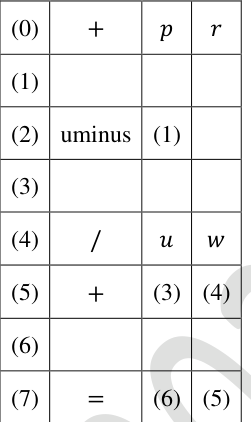
Consider the following expression: x[i]=(p+r)∗−s[i]+u/wx[i] = (p + r) * -s[i] + u/w. The following sequence shows the list of triples representing the given expression, with entries missing for triples (1), (3), and (6).

Which one of the following options fills in the missing entries CORRECTLY?
Question figure
Show answer without attempting

Answer: A

0/20 correct0 marks