Layering and Switching questions

Q21

GATE CS 2026 CS-2Layering and SwitchingMCQ1 mark−1/3 if wrong
Consider a file of size 4 million bytes being transferred between two hosts connected via a path consisting of three consecutive links of bandwidth 2 Mbps, 500 kbps, and 1 Mbps, respectively. All processing delays and propagation delays are negligible. Assume that there is no other background traffic over the path and no other additional overhead to transfer the file.

Which one of the following is the total time (in seconds) to transfer the file?

Note: 1M=1061\text{M}=10^6, 1k=1031\text{k}=10^3
Show answer without attempting

Answer: B
Q16

GATE CS 2025 CS-1Layering and SwitchingMCQ1 mark−1/3 if wrong
Identify the ONE CORRECT matching between the OSI layers and their corresponding functionalities as shown.

OSI Layers Functionalities
(a) Network layer (I) Packet routing
(b) Transport layer (II) Framing and error handling
(c) Datalink layer (III) Host to host communication
Show answer without attempting

Answer: B
Q17

GATE CS 2023 CSLayering and SwitchingMCQ1 mark−1/3 if wrong
Suppose two hosts are connected by a point-to-point link and they are configured to use Stop-and-Wait protocol for reliable data transfer. Identify in which one of the following scenarios, the utilization of the link is the lowest.
Show answer without attempting

Answer: B

Q22

GATE CS 2022 CSLayering and SwitchingMCQ1 mark−1/3 if wrong
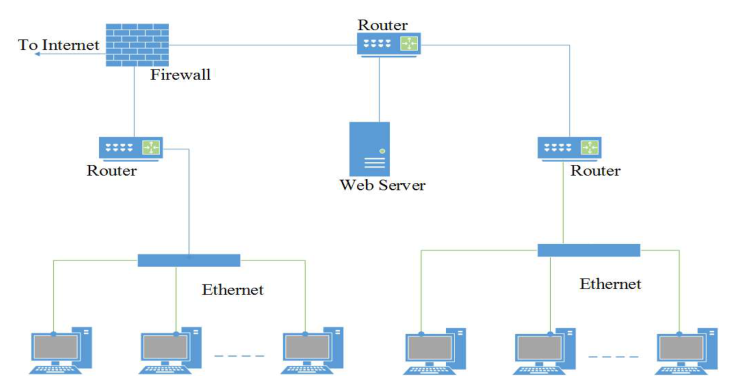
Consider an enterprise network with two Ethernet segments, a web server and a firewall, connected via three routers as shown below.

What is the number of subnets inside the enterprise network?
Question figure
Show answer without attempting

Answer: C

Q59

GATE CS 2022 CSLayering and SwitchingNAT2 marks
Consider a 100 Mbps link between an earth station (sender) and a satellite (receiver) at an altitude of 2100 km. The signal propagates at a speed of 3×1083 \times 10^8 m/s. The time taken (in milliseconds, rounded off to two decimal places) for the receiver to completely receive a packet of 1000 bytes transmitted by the sender is_________.
Show answer without attempting

Answer: 7.07 to 7.09

Q15

GATE CS 2017 CS-1Layering and SwitchingMCQ1 mark−1/3 if wrong
A sender S sends a message mm to receiver R, which is digitally signed by S with its private key. In this scenario, one or more of the following security violations can take place.

(I) S can launch a birthday attack to replace mm with a fraudulent message.
(II) A third party attacker can launch a birthday attack to replace mm with a fraudulent message.
(III) R can launch a birthday attack to replace mm with a fraudulent message.

Which of the following are possible security violations?
Show answer without attempting

Answer: B

Q45

GATE CS 2017 CS-1Layering and SwitchingNAT2 marks
The values of parameters for the Stop-and-Wait ARQ protocol are as given below:

Bit rate of the transmission channel = 1 Mbps1\text{ Mbps}.
Propagation delay from sender to receiver = 0.75 ms0.75\text{ ms}.
Time to process a frame = 0.25 ms0.25\text{ ms}.
Number of bytes in the information frame = 19801980.
Number of bytes in the acknowledge frame = 2020.
Number of overhead bytes in the information frame = 2020.

Assume that there are no transmission errors. Then, the transmission efficiency (expressed in percentage) of the Stop-and-Wait ARQ protocol for the above parameters is ____________ (correct to 2 decimal places).
Show answer without attempting

Answer: 86.5 to 89.5

Q35

GATE CS 2017 CS-2Layering and SwitchingMCQ2 marks−2/3 if wrong
Consider two hosts XX and YY, connected by a single direct link of rate 10610^6 bits/sec. The distance between the two hosts is 10,00010,000 km and the propagation speed along the link is 2×1082 \times 10^8 m/sec. Host XX sends a file of 50,00050,000 bytes as one large message to host YY continuously. Let the transmission and propagation delays be pp milliseconds and qq milliseconds, respectively. Then the values of pp and qq are
Show answer without attempting

Answer: D

Q24

GATE CS 2016 CS-1Layering and SwitchingMCQ1 mark−1/3 if wrong
Which one of the following protocols is NOT used to resolve one form of address to another one?
Show answer without attempting

Answer: C

Q55

GATE CS 2016 CS-1Layering and SwitchingNAT2 marks
A sender uses the Stop-and-Wait ARQ protocol for reliable transmission of frames. Frames are of size 1000 bytes and the transmission rate at the sender is 80 Kbps (1Kbps = 1000 bits/second). Size of an acknowledgement is 100 bytes and the transmission rate at the receiver is 8 Kbps. The one-way propagation delay is 100 milliseconds.
Assuming no frame is lost, the sender throughput is ________ bytes/second.
Show answer without attempting

Answer: 2500.0

Q23

GATE CS 2016 CS-2Layering and SwitchingMCQ1 mark−1/3 if wrong
Anarkali digitally signs a message and sends it to Salim. Verification of the signature by Salim requires
Show answer without attempting

Answer: A

Q55

GATE CS 2016 CS-2Layering and SwitchingNAT2 marks
Consider a 128×103128 \times 10^3 bits/second satellite communication link with one way propagation delay of 150 milliseconds. Selective retransmission (repeat) protocol is used on this link to send data with a frame size of 1 kilobyte. Neglect the transmission time of acknowledgement. The minimum number of bits required for the sequence number field to achieve 100% utilization is _________.
Show answer without attempting

Answer: 4.0

Q56

GATE CS 2015 CS-3Layering and SwitchingNAT2 marks
Two hosts are connected via a packet switch with 10710^7 bits per second links. Each link has a propagation delay of 20 microseconds. The switch begins forwarding a packet 35 microseconds after it receives the same. If 10000 bits of data are to be transmitted between the two hosts using a packet size of 5000 bits, the time elapsed between the transmission of the first bit of data and the reception of the last bit of the data in microseconds is ____________.
Show answer without attempting

Answer: 1575

Q36

GATE CS 2015 CS-1Layering and SwitchingNAT2 marks
Suppose that the stop-and-wait protocol is used on a link with a bit rate of 64 kilobits per second and 20 milliseconds propagation delay. Assume that the transmission time for the acknowledgement and the processing time at nodes are negligible. Then the minimum frame size in bytes to achieve a link utilization of at least 50% is ________.
Show answer without attempting

Answer: 160

Q34

GATE CS 2015 CS-2Layering and SwitchingNAT1 mark
A link has a transmission speed of 10610^6 bits/sec. It uses data packets of size 1000 bytes each. Assume that the acknowledgment has negligible transmission delay, and that its propagation delay is the same as the data propagation delay. Also assume that the processing delays at nodes are negligible. The efficiency of the stop-and-wait protocol in this setup is exactly 25%. The value of the one-way propagation delay (in milliseconds) is ____________.
Show answer without attempting

Answer: 12

Q26

GATE CS 2014 CS-2Layering and SwitchingMCQ2 marks−2/3 if wrong
Consider the store and forward packet switched network given below. Assume that the bandwidth of each link is 10610^6 bytes / sec. A user on host A sends a file of size 10310^3 bytes to host B through routers R1 and R2 in three different ways. In the first case a single packet containing the complete file is transmitted from A to B. In the second case, the file is split into 10 equal parts, and these packets are transmitted from A to B. In the third case, the file is split into 20 equal parts and these packets are sent from A to B. Each packet contains 100 bytes of header information along with the user data. Consider only transmission time and ignore processing, queuing and propagation delays. Also assume that there are no errors during transmission. Let T1, T2 and T3 be the times taken to transmit the file in the first, second and third case respectively. Which one of the following is CORRECT?

A — R1 — R2 — B
Show answer without attempting

Answer: D

Q27

GATE CS 2014 CS-2Layering and SwitchingMCQ2 marks−2/3 if wrong
An IP machine Q has a path to another IP machine H via three IP routers R1, R2, and R3.

Q—R1—R2—R3—H

H acts as an HTTP server, and Q connects to H via HTTP and downloads a file. Session layer encryption is used, with DES as the shared key encryption protocol. Consider the following four pieces of information:

[I1] The URL of the file downloaded by Q
[I2] The TCP port numbers at Q and H
[I3] The IP addresses of Q and H
[I4] The link layer addresses of Q and H

Which of I1, I2, I3, and I4 can an intruder learn through sniffing at R2 alone?
Show answer without attempting

Answer: C

Q23

GATE CS 2014 CS-3Layering and SwitchingMCQ1 mark−1/3 if wrong
In the following pairs of OSI protocol layer/sub-layer and its functionality, the INCORRECT pair is
Show answer without attempting

Answer: B

Q14

GATE CS 2013 CSLayering and SwitchingMCQ1 mark−1/3 if wrong
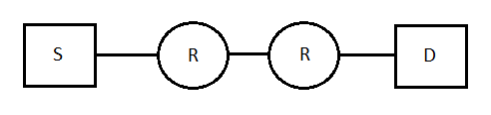
Assume that source S and destination D are connected through two intermediate routers labeled R. Determine how many times each packet has to visit the network layer and the data link layer during a transmission from S to D.
Question figure
Show answer without attempting

Answer: C

Q44

GATE CS 2012 CSLayering and SwitchingMCQ2 marks−2/3 if wrong
Consider a source computer (S) transmitting a file of size 10610^6 bits to a destination computer (D) over a network of two routers (R1R_1 and R2R_2) and three links (L1L_1, L2L_2, and L3L_3). L1L_1 connects S to R1R_1; L2L_2 connects R1R_1 to R2R_2; and L3L_3 connects R2R_2 to D. Let each link be of length 100 km. Assume signals travel over each link at a speed of 10810^8 meters per second. Assume that the link bandwidth on each link is 1Mbps. Let the file be broken down into 1000 packets each of size 1000 bits. Find the total sum of transmission and propagation delays in transmitting the file from S to D?
Show answer without attempting

Answer: A

0/200 correct0 marks

Related topics in Computer Networks