Sequential Circuits questions

Q37

GATE CS 2026 CS-1Sequential CircuitsMCQ2 marks−2/3 if wrong
Consider a 2-bit saturating up/down counter that performs the saturating up count when the input P is 0, and the saturating down count when P is 1. The Next State table of the counter is as shown. The counter is built as a synchronous sequential circuit using D flip-flops.

Input Current State Next State
PQ1Q0Q1+Q0+P \quad Q_1 \quad Q_0 \quad Q_1^+ \quad Q_0^+
0 0 0 0 1
0 0 1 1 0
0 1 0 1 1
0 1 1 1 1
1 0 0 0 0
1 0 1 0 0
1 1 0 0 1
1 1 1 1 0

Which one of the following options corresponds to the expressions for the inputs of the D flip-flops, D1D_1 and D0D_0?
Show answer without attempting

Answer: B
Q60

GATE CS 2025 CS-1Sequential CircuitsNAT2 marks
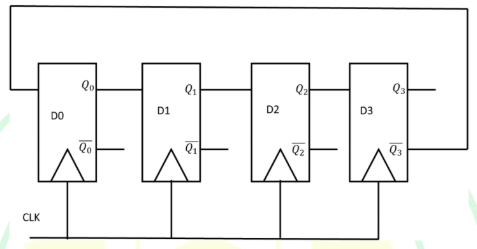
Consider the given sequential circuit designed using D-Flip-flops. The circuit is initialized with some value (initial state). The number of distinct states the circuit will go through before returning back to the initial state is _________ . (Answer in integer)
Question figure
Show answer without attempting

Answer: 7 to 8

Q34

GATE CS 2025 CS-2Sequential CircuitsNAT1 mark
In a 4-bit ripple counter, if the period of the waveform at the last flip-flop is 64 microseconds, then the frequency of the ripple counter in kHz is ________. (Answer in integer)
Show answer without attempting

Answer: 250

Q21

GATE CS 2023 CSSequential CircuitsMCQ1 mark−1/3 if wrong
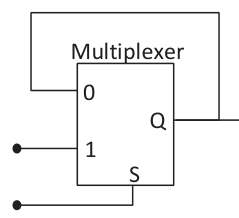
The output of a 2-input multiplexer is connected back to one of its inputs as shown in the figure.

Match the functional equivalence of this circuit to one of the following options.
Question figure
Show answer without attempting

Answer: B
Q43

GATE CS 2023 CSSequential CircuitsMCQ2 marks−2/3 if wrong
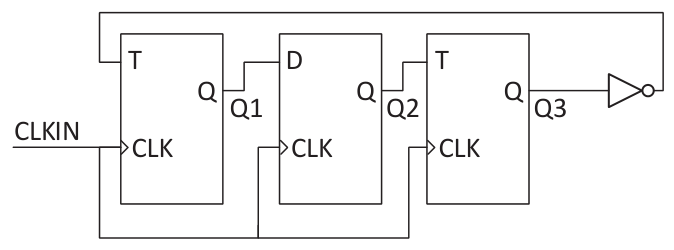
Consider a sequential digital circuit consisting of T flip-flops and D flip-flops as shown in the figure. CLKIN is the clock input to the circuit. At the beginning, Q1, Q2 and Q3 have values 0, 1 and 1, respectively.

Which one of the given values of (Q1, Q2, Q3) can NEVER be obtained with this digital circuit?
Question figure
Show answer without attempting

Answer: A

Q28

GATE CS 2021 CS-1Sequential CircuitsMCQ2 marks−2/3 if wrong
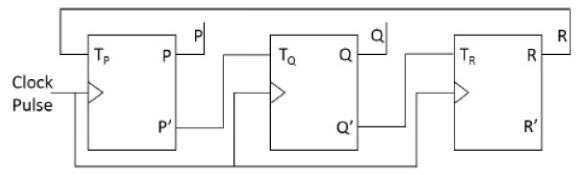
Consider a 3-bit counter, designed using T flip-flops, as shown below:
Assuming the initial state of the counter given by PQR as 000, what are the next three states?
Question figure
Show answer without attempting

Answer: A

Q28

GATE CS 2021 CS-2Sequential CircuitsMCQ2 marks−2/3 if wrong
Suppose we want to design a synchronous circuit that processes a string of 0's and 1's. Given a string, it produces another string by replacing the first 1 in any subsequence of consecutive 1's by a 0. Consider the following example.

<br>Input sequence:00100011000011100<br>Output sequence:00000001000001100<br>\begin{array}{rll}<br>\text{Input sequence:} & 00100011000011100 \\<br>\text{Output sequence:} & 00000001000001100 \\<br>\end{array}

A Mealy Machine is a state machine where both the next state and the output are functions of the present state and the current input.
The above mentioned circuit can be designed as a two-state Mealy machine. The states in the Mealy machine can be represented using Boolean values 0 and 1. We denote the current state, the next state, the next incoming bit, and the output bit of the Mealy machine by the variables ss, tt, bb and yy respectively. Assume the initial state of the Mealy machine is 0.

What are the Boolean expressions corresponding to tt and yy in terms of ss and bb?
Show answer without attempting

Answer: B
Q22

GATE CS 2018 CSSequential CircuitsNAT1 mark
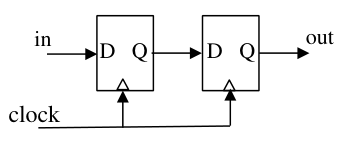
Consider the sequential circuit shown in the figure, where both flip-flops used are positive edge-triggered D flip-flops.

The number of states in the state transition diagram of this circuit that have a transition back to the same state on some value of "in" is _____.
Question figure
Show answer without attempting

Answer: 2

Q33

GATE CS 2017 CS-1Sequential CircuitsMCQ2 marks−2/3 if wrong
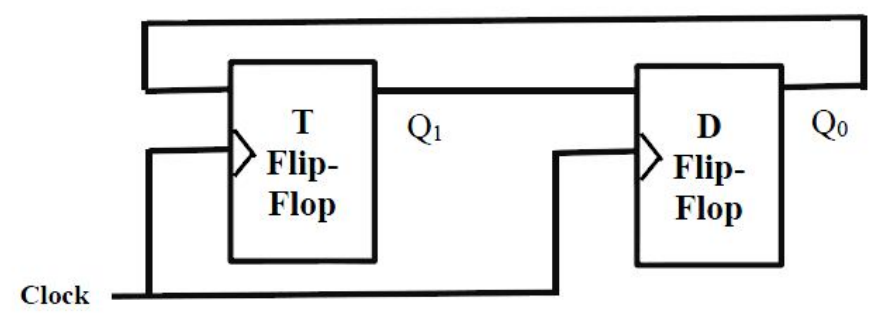
Consider a combination of T and D flip-flops connected as shown below. The output of the D flip-flop is connected to the input of the T flip-flop and the output of the T flip-flop is connected to the input of the D flip-flop.

Initially, both Q0Q_0 and Q1Q_1 are set to 11 (before the 1st1^{\text{st}} clock cycle). The outputs
Question figure
Show answer without attempting

Answer: B
Q42

GATE CS 2017 CS-2Sequential CircuitsMCQ2 marks−2/3 if wrong
The next state table of a 2-bit saturating up-counter is given below.
Q1Q_1Q0Q_0Q1+Q_1^+Q0+Q_0^+
0001
0110
1011
1111
The counter is built as a synchronous sequential circuit using T flip-flops. The expressions for T1T_1 and T0T_0 are
Show answer without attempting

Answer: B
Q8

GATE CS 2016 CS-1Sequential CircuitsNAT1 mark
We want to design a synchronous counter that counts the sequence 0-1-0-2-0-3 and then repeats. The minimum number of J-K flip-flops required to implement this counter is ________.
Show answer without attempting

Answer: 3.0 to 4.0

Q21

GATE CS 2015 CS-1Sequential CircuitsMCQ1 mark−1/3 if wrong
Consider a 4-bit Johnson counter with an initial value of 0000. The counting sequence of this counter is
Show answer without attempting

Answer: D

Q53

GATE CS 2015 CS-1Sequential CircuitsMCQ2 marks−2/3 if wrong
A positive edge-triggered D flip-flop is connected to a positive edge-triggered JK flip-flop as follows. The QQ output of the D flip-flop is connected to both the J and K inputs of the JK flip-flop, while the QQ output of the JK flip-flop is connected to the input of the D flip-flop. Initially, the output of the D flip-flop is set to logic one and the output of the JK flip-flop is cleared. Which one of the following is the bit sequence (including the initial state) generated at the QQ output of the JK flip-flop when the flip-flops are connected to a free-running common clock? Assume that J = K = 1 is the toggle mode and J = K = 0 is the state-holding mode of the JK flip-flop. Both the flip-flops have non-zero propagation delays.
Show answer without attempting

Answer: A

Q17

GATE CS 2015 CS-2Sequential CircuitsNAT1 mark
The minimum number of JK flip-flops required to construct a synchronous counter with the count sequence (0,0,1,1,2,2,3,3,0,0,…) is ___________.
Show answer without attempting

Answer: 3

Q7

GATE CS 2014 CS-2Sequential CircuitsMCQ1 mark−1/3 if wrong
Let k=2nk = 2^n. A circuit is built by giving the output of an nn-bit binary counter as input to an nn-to-2n2^n bit decoder. This circuit is equivalent to a
Show answer without attempting

Answer: C

Q45

GATE CS 2014 CS-3Sequential CircuitsMCQ2 marks−2/3 if wrong
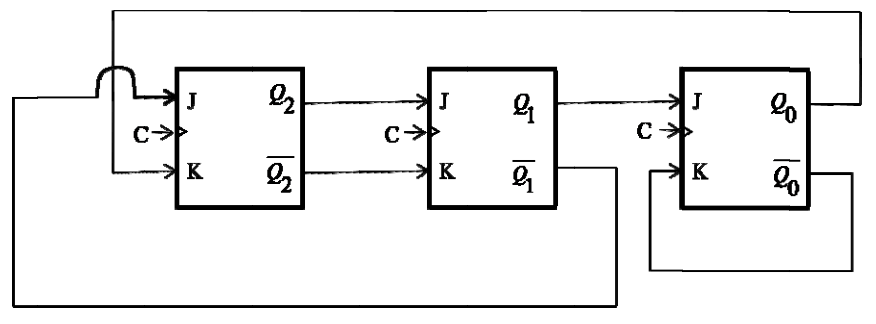
The above synchronous sequential circuit built using JK flip-flops is initialized with Q2Q1Q0=000Q_2Q_1Q_0 = 000. The state sequence for this circuit for the next 3 clock cycles is
Question figure
Show answer without attempting

Answer: C

0/160 correct0 marks

Related topics in Digital Logic