Probability and Statistics questions

Q18

GATE CS 2021 CS-1Probability and StatisticsNAT1 mark
The lifetime of a component of a certain type is a random variable whose probability density function is exponentially distributed with parameter 2. For a randomly picked component of this type, the probability that its lifetime exceeds the expected lifetime (rounded to 2 decimal places) is ______.
Show answer without attempting

Answer: 0.35 to 0.39
Q35

GATE CS 2021 CS-1Probability and StatisticsMCQ2 marks−2/3 if wrong
Consider the two statements.
S1S_1: There exist random variables XX and YY such that
(E[(X−E(X)) (Y−E(Y))])2>Var[X] Var[Y]\left(\mathbb{E}\left[(X - \mathbb{E}(X))\,(Y - \mathbb{E}(Y))\right]\right)^2 > \mathrm{Var}[X]\,\mathrm{Var}[Y]
S2S_2: For all random variables XX and YY,
Cov[X,Y]=E[ ∣X−E[X]∣ ∣Y−E[Y]∣ ]\mathrm{Cov}[X, Y] = \mathbb{E}\left[\,|X - \mathbb{E}[X]|\ |Y - \mathbb{E}[Y]|\,\right]
Which one of the following choices is correct?
Show answer without attempting

Answer: D

Q54

GATE CS 2021 CS-1Probability and StatisticsNAT2 marks
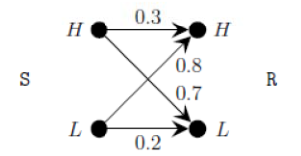
A sender (S) transmits a signal, which can be one of the two kinds: HH and LL with probabilities 0.1 and 0.9 respectively, to a receiver (R).
In the graph below, the weight of edge (u,v)(u, v) is the probability of receiving vv when uu is transmitted, where u,v∈{H,L}u, v \in \{H, L\}. For example, the probability that the received signal is LL given the transmitted signal was HH, is 0.7.
If the received signal is HH, the probability that the transmitted signal was HH (rounded to 2 decimal places) is ______.
Question figure
Show answer without attempting

Answer: 0.04

Q22

GATE CS 2021 CS-2Probability and StatisticsNAT1 mark
For a given biased coin, the probability that the outcome of a toss is a head is 0.4. This coin is tossed 1,000 times. Let X denote the random variable whose value is the number of times that head appeared in these 1,000 tosses. The standard deviation of X (rounded to 2 decimal places) is ____________.
Show answer without attempting

Answer: 15.00 to 16.00

Q29

GATE CS 2021 CS-2Probability and StatisticsMCQ2 marks−2/3 if wrong
In an examination, a student can choose the order in which two questions (QuesA and QuesB) must be attempted.
- If the first question is answered wrong, the student gets zero marks.
- If the first question is answered correctly and the second question is not answered correctly, the student gets the marks only for the first question.
- If both the questions are answered correctly, the student gets the sum of the marks of the two questions.
The following table shows the probability of correctly answering a question and the marks of the question respectively.

<br>questionprobability of answering correctlymarks<br>QuesA0.810<br>QuesB0.520<br>\begin{array}{c|c|c}<br>\text{question} & \text{probability of answering correctly} & \text{marks} \\ \hline<br>\text{QuesA} & 0.8 & 10 \\<br>\text{QuesB} & 0.5 & 20<br>\end{array}

Assuming that the student always wants to maximize her expected marks in the examination, in which order should she attempt the questions and what is the expected marks for that order (assume that the questions are independent)?
Show answer without attempting

Answer: D

Q33

GATE CS 2021 CS-2Probability and StatisticsMCQ2 marks−2/3 if wrong
A bag has rr red balls and bb black balls. All balls are identical except for their colours. In a trial, a ball is randomly drawn from the bag, its colour is noted and the ball is placed back into the bag along with another ball of the same colour. Note that the number of balls in the bag will increase by one, after the trial. A sequence of four such trials is conducted. Which one of the following choices gives the probability of drawing a red ball in the fourth trial?
Show answer without attempting

Answer: A

0/60 correct0 marks

Related topics in Engineering Mathematics