Q62
Let LIST be a datatype for an implementation of linked list defined as follows:
typedef struct list {
 int data;
 struct list *next;
} LIST;
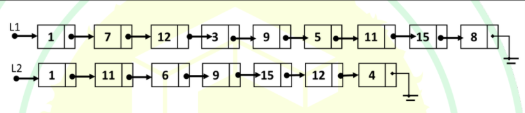
Suppose a program has created two linked lists, L1 and L2, whose contents are given in the figure below (code for creating L1 and L2 is not provided here). L1 contains 9 nodes, and L2 contains 7 nodes.
Consider the following C program segment that modifies the list L1. The number of nodes that will be there in L1 after the execution of the code segment is ________ . (Answer in integer)
int find (int query, LIST *list) {
 while (list != NULL){
 if(list->data == query) return 1;
 list = list->next;
 }
 return 0;
}
int main () {

 ptr1=L1; ptr2=L2;
 while (ptr1->next != NULL){
 query = ptr1->next->data;
 if (find (query, L2))
 ptr1->next = ptr1->next->next;
 else ptr1 = ptr1->next;
 }

 return 0;
}
Show answer without attempting
Answer: 5