Regular Languages questions — page 2 of 3

Q9

GATE CS 2021 CS-2Regular LanguagesMCQ1 mark−1/3 if wrong
Let L⊆{0,1}∗L \subseteq \{0,1\}^* be an arbitrary regular language accepted by a minimal DFA with kk states. Which one of the following languages must necessarily be accepted by a minimal DFA with kk states?
Show answer without attempting

Answer: C

Q17

GATE CS 2021 CS-2Regular LanguagesNAT1 mark
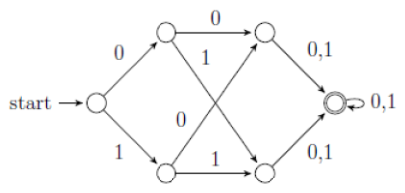
Consider the following deterministic finite automaton (DFA).

The number of strings of length 8 accepted by the above automaton is ____________.
Question figure
Show answer without attempting

Answer: 256

Q36

GATE CS 2021 CS-2Regular LanguagesMCQ2 marks−2/3 if wrong
Consider the following two statements about regular languages:
S1S_1: Every infinite regular language contains an undecidable language as a subset.
S2S_2: Every finite language is regular.
Which one of the following choices is correct?
Show answer without attempting

Answer: C

Q47

GATE CS 2021 CS-2Regular LanguagesMSQ2 marks
Which of the following regular expressions represent(s) the set of all binary numbers that are divisible by three? Assume that the string ϵ\epsilon is divisible by three.
More than one option can be correct.
Show answer without attempting

Answer: A, B, C

Q7

GATE CS 2020 CSRegular LanguagesMCQ1 mark−1/3 if wrong
Which one of the following regular expressions represents the set of all binary strings with an odd number of 1’s?
Show answer without attempting

Answer: Marks to all

Q8

GATE CS 2020 CSRegular LanguagesMCQ1 mark−1/3 if wrong
Consider the following statements.

I. If L1∪L2L_1 \cup L_2 is regular, then both L1L_1 and L2L_2 must be regular.
II. The class of regular languages is closed under infinite union.

Which of the above statements is/are TRUE?
Show answer without attempting

Answer: D

Q32

GATE CS 2020 CSRegular LanguagesMCQ2 marks−2/3 if wrong
Consider the following languages.

L1={wxyx∣w,x,y∈(0+1)+}L_1 = \{wxyx \mid w, x, y \in (0+1)^+\}
L2={xy∣x,y∈(a+b)∗,∣x∣=∣y∣,x≠y}L_2 = \{xy \mid x, y \in (a+b)^*, |x| = |y|, x \ne y\}

Which one of the following is TRUE?
Show answer without attempting

Answer: A

Q51

GATE CS 2020 CSRegular LanguagesNAT2 marks
Consider the following language.

L={x∈{a,b}∗∣number of a’s in x is divisible by 2 but not divisible by 3}L = \{x \in \{a, b\}^* \mid \text{number of } a\text{'s in } x \text{ is divisible by 2 but not divisible by 3}\}

The minimum number of states in a DFA that accepts LL is __________.
Show answer without attempting

Answer: 6

Q7

GATE CS 2019 CSRegular LanguagesMCQ1 mark−1/3 if wrong
If LL is a regular language over Σ={a,b}\Sigma = \{a, b\}, which one of the following languages is NOT regular?
Show answer without attempting

Answer: B

Q15

GATE CS 2019 CSRegular LanguagesMCQ1 mark−1/3 if wrong
For Σ={a,b}\Sigma = \{a, b\}, let us consider the regular language L={x∣x=a2+3k or x=b10+12k,k≥0}L = \{x \mid x = a^{2+3k} \text{ or } x = b^{10+12k}, k \ge 0\}. Which one of the following can be a pumping length (the constant guaranteed by the pumping lemma) for LL?
Show answer without attempting

Answer: D

Q48

GATE CS 2019 CSRegular LanguagesNAT2 marks
Let Σ\Sigma be the set of all bijections from {1,...,5}\{1, ..., 5\} to {1,...,5}\{1, ..., 5\}, where idid denotes the identity function, i.e. id(j)=j,∀jid(j) = j, \forall j. Let ∘\circ denote composition on functions. For a string x=x1x2⋯xn∈Σn,n≥0x = x_1 x_2 \cdots x_n \in \Sigma^n, n \ge 0, let π(x)=x1∘x2∘⋯∘xn\pi(x) = x_1 \circ x_2 \circ \cdots \circ x_n.
Consider the language L={x∈Σ∗∣π(x)=id}L = \{x \in \Sigma^* \mid \pi(x) = id\}. The minimum number of states in any DFA accepting LL is __________.
Show answer without attempting

Answer: 120

Q6

GATE CS 2018 CSRegular LanguagesMCQ1 mark−1/3 if wrong
Let N be an NFA with nn states. Let kk be the number of states of a minimal DFA which is equivalent to N. Which one of the following is necessarily true?
Show answer without attempting

Answer: D

Q52

GATE CS 2018 CSRegular LanguagesNAT2 marks
Given a language LL, define LiL^i as follows:

L0={ε}L^0 = \{\varepsilon\}
Li=Li−1⋅L for all i>0L^i = L^{i-1} \cdot L \text{ for all } i > 0

The order of a language LL is defined as the smallest kk such that Lk=Lk+1L^k = L^{k+1}.
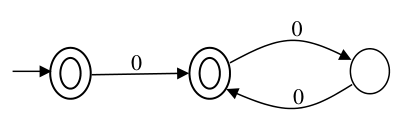
Consider the language L1L_1 (over alphabet 0) accepted by the following automaton.

The order of L1L_1 is _____.
Question figure
Show answer without attempting

Answer: 2

Q22

GATE CS 2017 CS-1Regular LanguagesNAT1 mark
Consider the language LL given by the regular expression (a+b)∗b(a+b)(a+b)^*b(a+b) over the alphabet {a,b}\{a, b\}. The smallest number of states needed in a deterministic finite-state automaton (DFA) accepting LL is ____________.
Show answer without attempting

Answer: 4.0

Q25

GATE CS 2017 CS-2Regular LanguagesNAT1 mark
The minimum possible number of states of a deterministic finite automaton that accepts the regular language L={w1aw2∣w1,w2∈{a,b}∗,∣w1∣=2,∣w2∣≥3}L = \{w_1 a w_2 \mid w_1, w_2 \in \{a, b\}^*, \lvert w_1 \rvert = 2, \lvert w_2 \rvert \ge 3\} is ____________.
Show answer without attempting

Answer: 8.0

Q39

GATE CS 2017 CS-2Regular LanguagesMCQ2 marks−2/3 if wrong
Let δ\delta denote the transition function and δ^\widehat{\delta} denote the extended transition function of the ϵ\epsilon-NFA whose transition table is given below:
δ\deltaϵ\epsilonaabb
→q0\rightarrow q_0{q2}\{q_2\}{q1}\{q_1\}{q0}\{q_0\}
q1q_1{q2}\{q_2\}{q2}\{q_2\}{q3}\{q_3\}
q2q_2{q0}\{q_0\}∅\emptyset∅\emptyset
q3q_3∅\emptyset∅\emptyset{q2}\{q_2\}
Then δ^(q2,aba)\widehat{\delta}(q_2, aba) is
Show answer without attempting

Answer: C

Q40

GATE CS 2017 CS-2Regular LanguagesMCQ2 marks−2/3 if wrong
Consider the following languages.

L1={ap∣p is a prime number}L_1 = \{a^p \mid p \text{ is a prime number}\}
L2={anbmc2m∣n≥0,m≥0}L_2 = \{a^n b^m c^{2m} \mid n \ge 0, m \ge 0\}
L3={anbnc2n∣n≥0}L_3 = \{a^n b^n c^{2n} \mid n \ge 0\}
L4={anbn∣n≥1}L_4 = \{a^n b^n \mid n \ge 1\}

Which of the following are CORRECT?

I. L1L_1 is context-free but not regular.
II. L2L_2 is not context-free.
III. L3L_3 is not context-free but recursive.
IV. L4L_4 is deterministic context-free.
Show answer without attempting

Answer: D

Q16

GATE CS 2016 CS-1Regular LanguagesMCQ1 mark−1/3 if wrong
Which of the following languages is generated by the given grammar?
S⟶aS∣bS∣ϵS \longrightarrow aS \mid bS \mid \epsilon
Show answer without attempting

Answer: D

Q18

GATE CS 2016 CS-1Regular LanguagesMCQ1 mark−1/3 if wrong
Which one of the following regular expressions represents the language: the set of all binary strings having two consecutive 0s and two consecutive 1s?
Show answer without attempting

Answer: B

Q16

GATE CS 2016 CS-2Regular LanguagesNAT1 mark
The number of states in the minimum sized DFA that accepts the language defined by the regular expression
(0+1)∗(0+1)(0+1)∗(0+1)^*(0+1)(0+1)^*
is _________.
Show answer without attempting

Answer: 2.0

0/200 correct0 marks

Related topics in Theory of Computation