Regular Languages questions

Q38

GATE CS 2021 CS-1Regular LanguagesMCQ2 marks−2/3 if wrong
Consider the following language.
L={w∈{0,1}∗∣w ends with the substring 011}L = \{w \in \{0, 1\}^* \mid w \text{ ends with the substring } 011\}
Which one of the following deterministic finite automata accepts LL?
Show answer without attempting

Answer: D

Q9

GATE CS 2021 CS-2Regular LanguagesMCQ1 mark−1/3 if wrong
Let L⊆{0,1}∗L \subseteq \{0,1\}^* be an arbitrary regular language accepted by a minimal DFA with kk states. Which one of the following languages must necessarily be accepted by a minimal DFA with kk states?
Show answer without attempting

Answer: C

Q17

GATE CS 2021 CS-2Regular LanguagesNAT1 mark
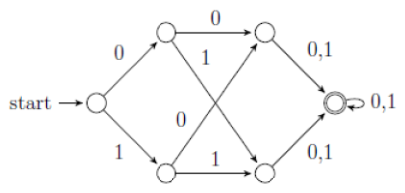
Consider the following deterministic finite automaton (DFA).

The number of strings of length 8 accepted by the above automaton is ____________.
Question figure
Show answer without attempting

Answer: 256

Q36

GATE CS 2021 CS-2Regular LanguagesMCQ2 marks−2/3 if wrong
Consider the following two statements about regular languages:
S1S_1: Every infinite regular language contains an undecidable language as a subset.
S2S_2: Every finite language is regular.
Which one of the following choices is correct?
Show answer without attempting

Answer: C

Q47

GATE CS 2021 CS-2Regular LanguagesMSQ2 marks
Which of the following regular expressions represent(s) the set of all binary numbers that are divisible by three? Assume that the string ϵ\epsilon is divisible by three.
More than one option can be correct.
Show answer without attempting

Answer: A, B, C

0/50 correct0 marks

Related topics in Theory of Computation