British Expansion & Colonial Policies questions

Q.1

30 Nov 2025 Shift 1
The rebellions that broke out at regular intervals against the British authorities in the hill region of Visakhapatnam, popularly known as the Gudem area, were due to which of the following reason(s)? 1. The feudal affinities of the muttadars with the Bhupathi family of Golconda zamindari 2. Placing the ex-zamindari family on the seat of Golconda 3. British authorities' refusal to grant annual maintenance for the Bhupathi family Select the answer using the codes given below :
Show answer without attempting

Answer: C — 1 and 3

Open question page
Q.2

30 Nov 2025 Shift 1
Consider the following : 1. Deccan Revolt 2. Santhal Rebellion 3. Kherwar Movement 4. Rampa Rebellion Which of the following is the correct chronological order of the above (starting with the earliest) ?
Show answer without attempting

Answer: C — 2-3-1-4

Open question page

Q.3

2 Jul 2023 Shift 1
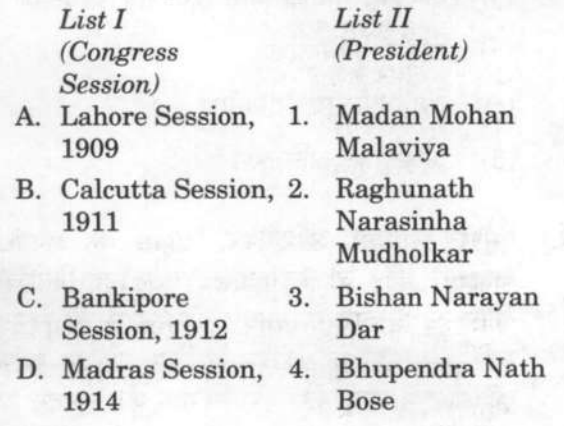
Match List I with List II and select the correct answer using the code given below the Lists :
Question figure
Show answer without attempting

Answer: A — A-1, B-3, C-2, D-4

Open question page

Q.4

2 Jul 2023 Shift 1
Who among the following was a companion of freedom fighter Rani Chennamma of Kittur and continued the fight against the British after the Rani's capture by the British in 1824 ?
Show answer without attempting

Answer: A — Rayanna

Open question page

Q.5

2 Jul 2023 Shift 1
In 1927, Lord Birkenhead, Secretary of State for India, appointed a Committee of three members to enquire into the relationship between the Indian States and the British Government and to make suggestions for more satisfactory adjustment of the existing economic relations between the Indian States and British India. Who among the following was not a member of the Committee ?
Show answer without attempting

Answer: B — A.J. Wilson

Open question page

Q.6

2 Jul 2023 Shift 1
Which of the following statements are correct ?
1. Under the Cornwallis System, the districts were divided into thanas or police jurisdictions of 20 – 30 miles square.
2. Each of them was placed under an officer of government, under the denomination of daroga.
3. The daroga system was introduced in Madras in 1812.
4. The daroga was nominated by the district magistrate.
Select the correct answer using the code given below :
Show answer without attempting

Answer: D — 1, 2 and 4

Open question page

Q.7

5 Sep 2021 Shift 1
Which one of the following was not recommended in Macaulay's 1835 Minute on Education ?
Show answer without attempting

Answer: D — Teaching of both Western and Oriental texts at higher levels of education

Open question page

Q.8

5 Sep 2021 Shift 1
Which one of the following statements about the situation in the Ryotwari areas is correct ?
Show answer without attempting

Answer: A — A large amount of land passed into the hands of the money lenders, merchants and rich peasants, who usually utilised the services of the tenants.

Open question page

Q.9

26 Feb 2017 Shift 1
Who is the author of the work, The Evolution of Provincial Finance in British India : A Study in the Provincial Decentralization of Imperial Finance?
Show answer without attempting

Answer: B — Dr. B. R. Ambedkar

Open question page

Q.10

26 Feb 2017 Shift 1
In the context of international affairs, which one of the following is correct about Lord Curzon?
Show answer without attempting

Answer: B — He wanted to establish a British sphere of influence over the Persian Gulf and Seistan.

Open question page

Q.11

26 Feb 2017 Shift 1
Which one of the following is correct about Assam in British India?
Show answer without attempting

Answer: C — It was separated from Bengal in 1874, and along with Sylhet made into a Chief Commissioner’s province.

Open question page

Q.12

26 Feb 2017 Shift 1
Which of the following was/were the reason/reasons for the lack of economic development in India in the 19th century? 1. Officially the British Government was committed to a policy of laissez-faire, but it was actually a policy of discriminatory intervention. 2. European entrepreneurs had connections to banks and agency houses, while Indians had to rely on kin, family and caste men. 3. When plantations were transferred to individual capitalist ownership, native investors were deliberately ignored. Select the correct answer using the code given below.
Show answer without attempting

Answer: D — 1, 2 and 3

Open question page

Q.13

10 Jan 2016 Shift 1
What is the chronological sequence of the following developments ? 1. Decline in the export of Indian cotton 2. Cotton boom in India 3. Civil War in America Select the correct answer using the codes given below :
Show answer without attempting

Answer: A — 1, 3 and 2

Open question page

Q.14

10 Jan 2016 Shift 1
Which of the following industries were first established during the British Rule in India ?
Show answer without attempting

Answer: A — Cotton Textile Industry; and Jute Industry

Open question page

Q.15

23 Sep 2012 Shift 1
Which one of the following sets of industries were among first modern industries in India ?
Show answer without attempting

Answer: C — Cotton, Jute and Coal-Mines

Open question page

Q.16

23 Sep 2012 Shift 1
Consider the following statements : 1. By the early nineteenth century British carried out detailed surveys. 2. The effort was to know the topography, the soil quality, the flora, the fauna, the logical histories and the cropping pattern. Which of these statements is/are correct ?
Show answer without attempting

Answer: C — Both 1 and 2

Open question page

Related topics in Modern Indian History

0/160 correct0 marks