Q.1
2 Jul 2023 Shift 1Show answer without attempting
Answer: D — The Governor-General-in-Council was authorized to appoint successors to Bombay and Madras Presidencies.
Open question pageUPSC EPFO · 19 questions
19 Indian Freedom Struggle questions asked in UPSC EPFO previous year papers (2023), each with the correct answer and an explanation. Pick an option on any question to practise it.
Answer: D — The Governor-General-in-Council was authorized to appoint successors to Bombay and Madras Presidencies.
Open question pageAnswer: C — It retained the authority of the Secretary of State over the Government of India.
Open question page
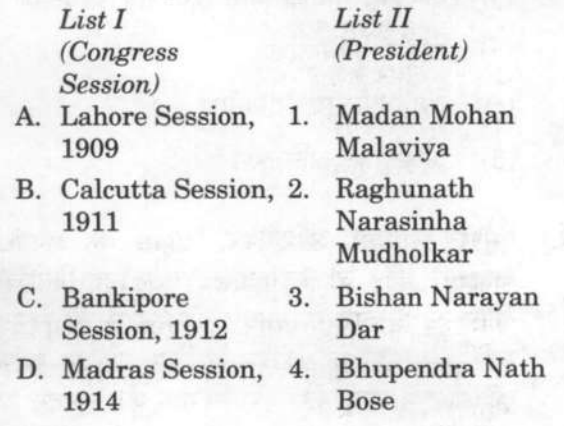
Answer: A — A-1, B-3, C-2, D-4
Open question pageAnswer: D — B.S. Moonje
Open question pageAnswer: B — 4-3-1-2
Open question pageAnswer: A — Rayanna
Open question pageAnswer: A — Singapore
Open question pageAnswer: B — A.J. Wilson
Open question pageAnswer: D — 1, 2 and 4
Open question pageAnswer: A — Alexander Cunningham, the first Director-General of the Archaeological Survey of India, was of the view that the history of India began with the origins of the Indus Valley Civilization.
Open question pageAnswer: C — An agriculturally productive region
Open question pageAnswer: C — The superstructure of the temple corresponds to the Nagara style.
Open question pageAnswer: A — Northern Black Polished Ware (NBPW) refers to a type of pottery found from archaeological sites in India dating back to 600 BCE.
Open question pageAnswer: B — Harmika : A style of temple architecture that originated under the Chola Kings
Open question pageAnswer: C — Tamraparni river in the Pandyan Kingdom
Open question pageAnswer: D — Tuluva Dynasty—Gunda
Open question pageAnswer: A — Peddavegi
Open question pageAnswer: C — Brahmapala
Open question pageAnswer: B — Burma Front
Open question page0/190 correct0 marks