Routing questions

Q40

GATE CS 2025 CS-1RoutingMCQ2 marks−2/3 if wrong
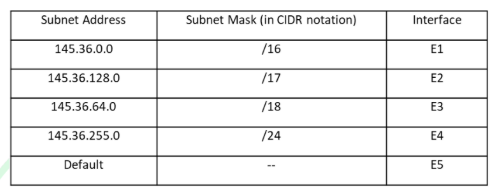
A packet with the destination IP address 145.36.109.70 arrives at a router whose routing table is shown. Which interface will the packet be forwarded to?
Question figure
Show answer without attempting

Answer: A

Q17

GATE CS 2025 CS-2RoutingMCQ1 mark−1/3 if wrong
Consider the routing protocols given in List I and the names given in List II:
List IList II
(i) Distance vector routing(a) Bellman-Ford
(ii) Link state routing(b) Dijkstra
For matching of items in List I with those in List II, which ONE of the following options is CORRECT?
Show answer without attempting

Answer: A

Q58

GATE CS 2024 CS-1RoutingNAT2 marks
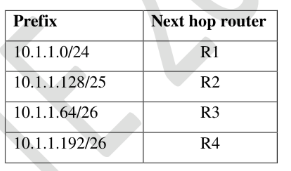
Consider the entries shown below in the forwarding table of an IP router. Each entry consists of an IP prefix and the corresponding next hop router for packets whose destination IP address matches the prefix. The notation "/N" in a prefix indicates a subnet mask with the most significant N bits set to 1.

This router forwards 20 packets each to 5 hosts. The IP addresses of the hosts are 10.1.1.16, 10.1.1.72, 10.1.1.132, 10.1.1.191, and 10.1.1.205 . The number of packets forwarded via the next hop router R2 is _______
Question figure
Show answer without attempting

Answer: 40

Q25

GATE CS 2023 CSRoutingMSQ1 mark
Which of the following statements is/are INCORRECT about the OSPF (Open Shortest Path First) routing protocol used in the Internet?
More than one option can be correct.
Show answer without attempting

Answer: A, C

Q57

GATE CS 2022 CSRoutingNAT2 marks
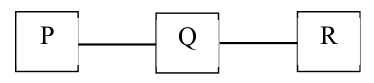
Consider a network with three routers P, Q, R shown in the figure below. All the links have cost of unity.

The routers exchange distance vector routing information and have converged on the routing tables, after which the link Q-R fails. Assume that P and Q send out routing updates at random times, each at the same average rate. The probability of a routing loop formation (rounded off to one decimal place) between P and Q, leading to count-to-infinity problem, is___________.
Question figure
Show answer without attempting

Answer: 0.5

Q45

GATE CS 2021 CS-2RoutingMSQ2 marks
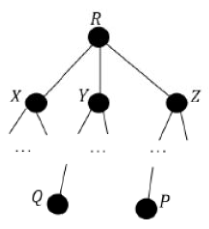
Consider a computer network using the distance vector routing algorithm in its network layer. The partial topology of the network is as shown below.

The objective is to find the shortest-cost path from the router RR to routers PP and QQ. Assume that RR does not initially know the shortest routes to PP and QQ. Assume that RR has three neighbouring routers denoted as XX, YY, and ZZ. During one iteration, RR measures its distance to its neighbours XX, YY, and ZZ as 3, 2, and 5, respectively. Router RR gets routing vectors from its neighbours that indicate that the distance to router PP from routers XX, YY, and ZZ are 7, 6, and 5, respectively. The routing vector also indicates that the distance to router QQ from routers XX, YY, and ZZ are 4, 6, and 8, respectively. Which of the following statement(s) is/are correct with respect to the new routing table of RR, after updation during this iteration?
Question figure
More than one option can be correct.
Show answer without attempting

Answer: B, C

Q9

GATE CS 2017 CS-2RoutingMCQ1 mark−1/3 if wrong
Consider the following statements about the routing protocols, Routing Information Protocol (RIP) and Open Shortest Path First (OSPF) in an IPv4 network.

I: RIP uses distance vector routing
II: RIP packets are sent using UDP
III: OSPF packets are sent using TCP
IV: OSPF operation is based on link-state routing

Which of the statements above are CORRECT?
Show answer without attempting

Answer: C

Q23

GATE CS 2014 CS-2RoutingMCQ1 mark−1/3 if wrong
Which one of the following is TRUE about the interior gateway routing protocols – Routing Information Protocol (RIP) and Open Shortest Path First (OSPF)?
Show answer without attempting

Answer: A

Q23

GATE CS 2014 CS-1RoutingMCQ1 mark−1/3 if wrong
Consider the following three statements about link state and distance vector routing protocols, for a large network with 500 network nodes and 4000 links.

[S1] The computational overhead in link state protocols is higher than in distance vector protocols.
[S2] A distance vector protocol (with split horizon) avoids persistent routing loops, but not a link state protocol.
[S3] After a topology change, a link state protocol will converge faster than a distance vector protocol.

Which one of the following is correct about S1, S2, and S3 ?
Show answer without attempting

Answer: D

0/90 correct0 marks

Related topics in Computer Networks