Q45
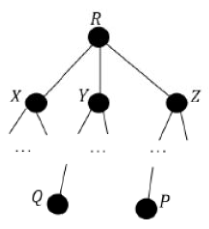
Consider a computer network using the distance vector routing algorithm in its network layer. The partial topology of the network is as shown below.
The objective is to find the shortest-cost path from the router to routers and . Assume that does not initially know the shortest routes to and . Assume that has three neighbouring routers denoted as , , and . During one iteration, measures its distance to its neighbours , , and as 3, 2, and 5, respectively. Router gets routing vectors from its neighbours that indicate that the distance to router from routers , , and are 7, 6, and 5, respectively. The routing vector also indicates that the distance to router from routers , , and are 4, 6, and 8, respectively. Which of the following statement(s) is/are correct with respect to the new routing table of , after updation during this iteration?
The objective is to find the shortest-cost path from the router to routers and . Assume that does not initially know the shortest routes to and . Assume that has three neighbouring routers denoted as , , and . During one iteration, measures its distance to its neighbours , , and as 3, 2, and 5, respectively. Router gets routing vectors from its neighbours that indicate that the distance to router from routers , , and are 7, 6, and 5, respectively. The routing vector also indicates that the distance to router from routers , , and are 4, 6, and 8, respectively. Which of the following statement(s) is/are correct with respect to the new routing table of , after updation during this iteration?
More than one option can be correct.
Show answer without attempting
Answer: B, C