Computer Networks questions

Q11

GATE CS 2013 CSApplication LayerMCQ1 mark−1/3 if wrong
Match the problem domains in GROUP I with the solution technologies in GROUP II.
GROUP IGROUP II
(P) Service oriented computing(1) Interoperability
(Q) Heterogeneous communicating systems(2) BPMN
(R) Information representation(3) Publish-find-bind
(S) Process description(4) XML
Show answer without attempting

Answer: C
Q12

GATE CS 2013 CSTransport LayerMCQ1 mark−1/3 if wrong
The transport layer protocols used for real time multimedia, file transfer, DNS and email, respectively are
Show answer without attempting

Answer: C
Q13

GATE CS 2013 CSTransport LayerMCQ1 mark−1/3 if wrong
Using public key cryptography, X adds a digital signature σ\sigma to message MM, encrypts ⟨M,σ⟩\langle M, \sigma \rangle, and sends it to Y, where it is decrypted. Which one of the following sequences of keys is used for the operations?
Show answer without attempting

Answer: D

Q14

GATE CS 2013 CSLayering and SwitchingMCQ1 mark−1/3 if wrong
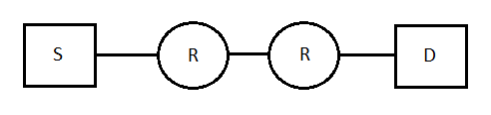
Assume that source S and destination D are connected through two intermediate routers labeled R. Determine how many times each packet has to visit the network layer and the data link layer during a transmission from S to D.
Question figure
Show answer without attempting

Answer: C

Q36

GATE CS 2013 CSData Link LayerMCQ2 marks−2/3 if wrong
Determine the maximum length of the cable (in km) for transmitting data at a rate of 500 Mbps in an Ethernet LAN with frames of size 10,000 bits. Assume the signal speed in the cable to be 2,00,000 km/s.
Show answer without attempting

Answer: B

Q37

GATE CS 2013 CSIPv4MCQ2 marks−2/3 if wrong
In an IPv4 datagram, the M bit is 0, the value of HLEN is 10, the value of total length is 400 and the fragment offset value is 300. The position of the datagram, the sequence numbers of the first and the last bytes of the payload, respectively are
Show answer without attempting

Answer: C

Q38

GATE CS 2013 CSApplication LayerMCQ2 marks−2/3 if wrong
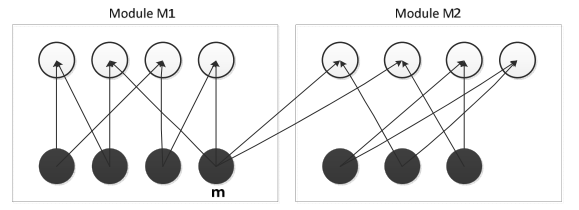
The following figure represents access graphs of two modules M1 and M2. The filled circles represent methods and the unfilled circles represent attributes. If method m is moved to module M2 keeping the attributes where they are, what can we say about the average cohesion and coupling between modules in the system of two modules?
Question figure
Show answer without attempting

Answer: A

0/70 correct0 marks

Related topics in GATE CS