Computer Organization and Architecture questions — page 1 of 6

Q14

GATE CS 2026 CS-1Instruction Set and AddressingMCQ1 mark−1/3 if wrong
Match each addressing mode in List I with a data element or an element of a data structure (in a high-level language) in List II:

List I
P. Immediate
Q. Indirect
R. Base with index
S. Base with offset/displacement

List II
1. Element of an array
2. Pointer
3. Element of a record
4. Constant
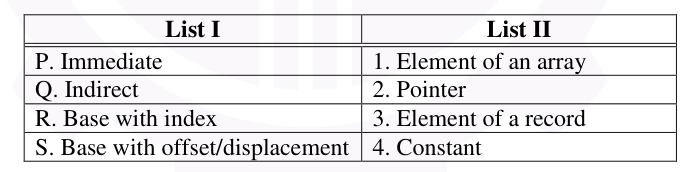
Question figure
Show answer without attempting

Answer: B
Q15

GATE CS 2026 CS-1Instruction Set and AddressingMCQ1 mark−1/3 if wrong
Consider a processor P whose instruction set architecture is the load-store architecture. The instruction format is such that the first operand of any instruction is the destination operand.

Which one of the following sequences of instructions corresponds to the high-level language statement Z = X + Y ?

Note: X, Y, and Z are memory operands. R0, R1, and R2 are registers.
Show answer without attempting

Answer: D

Q16

GATE CS 2026 CS-1Instruction PipeliningMCQ1 mark−1/3 if wrong
Which one of the following dependencies among the register operands of different instructions can cause a data hazard in a pipelined processor?
Show answer without attempting

Answer: B
Q38

GATE CS 2026 CS-1Memory HierarchyMCQ2 marks−2/3 if wrong
The size of the physical address space of a processor is 2322^{32} bytes. The capacity of a cache memory unit is 2232^{23} bytes. The cache block size is 128 bytes. The cache memory unit can be built as a direct mapped cache or as a KK-way set-associative cache, where K=2LK = 2^L and L∈{1,2,3}L \in \{1, 2, 3\}. Let the length of the TAG field be MM bits for the direct mapped cache, and NN bits for the set-associative cache.

Which one of the following options is true?
Show answer without attempting

Answer: A

Q60

GATE CS 2026 CS-1Instruction PipeliningNAT2 marks
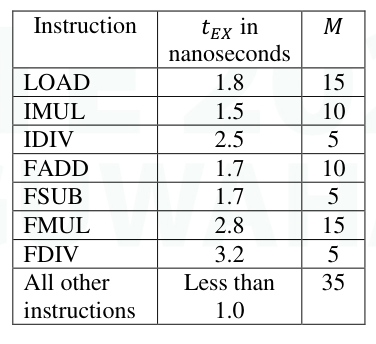
The EX stage of a pipelined processor performs the memory read operations for LOAD instructions, and the operations for the arithmetic and logic instructions. Let tEXt_{EX} denote the time taken by the EX stage to perform the operation for an instruction. For each instruction type, the values of tEXt_{EX} and MM (the number of instructions of that type in a sequence of 100 instructions for a program P), are given in the table below.

The duration of the pipeline clock cycle is 1 nanosecond. Assume that the latch time for the interstage buffers in the pipeline is negligible.

When program P is executed, the number of clock cycles for which the pipeline is stalled due to structural hazards in the EX stage is ______. (answer in integer)
Question figure
Show answer without attempting

Answer: 95

Q18

GATE CS 2026 CS-2Input OutputMCQ1 mark−1/3 if wrong
Consider the following two statements about interrupt handling mechanisms in a CPU.

S1: In non-vectored interrupt mechanism, it usually takes more time to start the Interrupt Service Routine (ISR) when compared to that in a vectored interrupt mechanism.

S2: In daisy-chain interrupt mechanism, the CPU polls all the input devices individually to determine the source of the interrupt.

Which one of the following options is correct with respect to S1 and S2 ?
Show answer without attempting

Answer: C

Q44

GATE CS 2026 CS-2Instruction Set and AddressingMCQ2 marks−2/3 if wrong
Consider a processor that has 16 general purpose registers and it uses 2-byte instruction format for all its instructions. Variable-sized opcodes are permitted. There are three different types of instructions; M-type, R-type, and C-type. Each M-type instruction has 2 register operands and a 6-bit immediate operand. Each R-type instruction has 3 register operands. Each C-type instruction has a register operand and a 6-bit offset value. If there are 2 unique M-type opcodes and 7 unique R-type opcodes, which one of the following options gives the maximum number of unique opcodes possible for C-type instructions?
Show answer without attempting

Answer: B
Q52

GATE CS 2026 CS-2Memory HierarchyMSQ2 marks
Consider a system with a processor and a 4 KB direct mapped cache with block size of 16 bytes. The system has a 16 MB physical memory. Four words P, Q, R, and S are accessed by the processor in the same order 10 times. That is, there are a total of 40 memory references in the sequence P, Q, R, S, P, Q, R, S,…

Assume that the cache memory is initially empty. The physical addresses of the words are given below (1 word = 1 byte).

P: 0x845B32, Q: 0x845B26, R: 0x845B36, S: 0x846B32

Which of the following statements is/are true?

Note: 1K=2101\text{K}=2^{10} and 1M=2201\text{M}=2^{20}
More than one option can be correct.
Show answer without attempting

Answer: A, B

Q56

GATE CS 2026 CS-2Memory HierarchyNAT2 marks
Consider a system with 1 MB physical memory and a word length of 1 byte. The system uses a direct mapped cache, with block numbers starting from 0. The word with physical address 0xA2C28 is mapped to the cache block number 17610176_{10}. The maximum possible size of the cache (in KB) for this configuration is ___________. (answer in integer)

Note: 1K=2101\text{K}=2^{10} and 1M=2201\text{M}=2^{20}
Show answer without attempting

Answer: 128

Q57

GATE CS 2026 CS-2Instruction PipeliningNAT2 marks
A non-pipelined instruction execution unit that operates at 1.6 GHz clock takes an average of 5 clock cycles to complete the execution of an instruction. To improve the performance, the system was pipelined with a goal of achieving an average throughput of one instruction per clock cycle. However, it could operate only at 1.2 GHz due to pipeline overheads. While executing a program in the pipelined design, 30% of instructions encountered a stall of 2 cycles due to pipeline hazards. The speed-up obtained by the pipelined design over the non-pipelined one for this program is ___________. (rounded off to two decimal places)

Note: 1G=1091\text{G}=10^9
Show answer without attempting

Answer: 2.30 to 2.40

Q11

GATE CS 2025 CS-1Input OutputMCQ1 mark−1/3 if wrong
Suppose a program is running on a non-pipelined single processor computer system. The computer is connected to an external device that can interrupt the processor asynchronously. The processor needs to execute the interrupt service routine (ISR) to serve this interrupt. The following steps (not necessarily in order) are taken by the processor when the interrupt arrives:
(i) The processor saves the content of the program counter.
(ii) The program counter is loaded with the start address of the ISR.
(iii) The processor finishes the present instruction.
Which ONE of the following is the CORRECT sequence of steps?
Show answer without attempting

Answer: A

Q27

GATE CS 2025 CS-1Instruction Set and AddressingMSQ1 mark
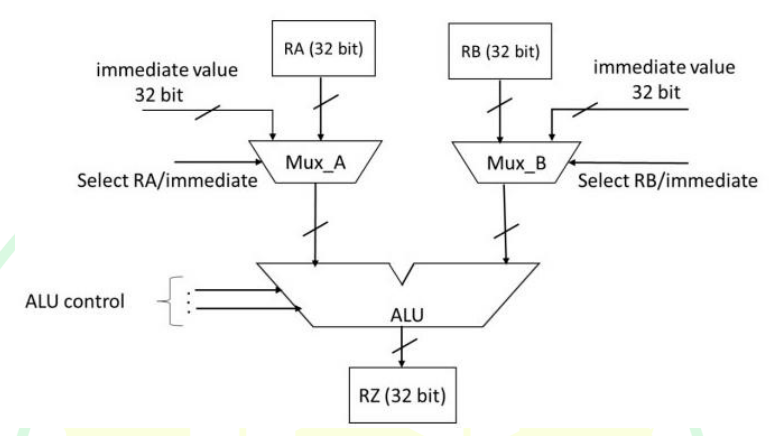
A partial data path of a processor is given in the figure, where RA, RB, and RZ are 32-bit registers. Which option(s) is/are CORRECT related to arithmetic operations using the data path as shown?
Question figure
More than one option can be correct.
Show answer without attempting

Answer: A, B, C

Q36

GATE CS 2025 CS-1Memory HierarchyMCQ2 marks−2/3 if wrong
Consider a memory system with 1M bytes of main memory and 16K bytes of cache memory. Assume that the processor generates 20-bit memory address, and the cache block size is 16 bytes. If the cache uses direct mapping, how many bits will be required to store all the tag values? [Assume memory is byte addressable, 1K=2101\text{K}=2^{10}, 1M=2201\text{M}=2^{20}.]
Show answer without attempting

Answer: A

Q37

GATE CS 2025 CS-1Instruction Set and AddressingMCQ2 marks−2/3 if wrong
A processor has 64 general-purpose registers and 50 distinct instruction types. An instruction is encoded in 32-bits. What is the maximum number of bits that can be used to store the immediate operand for the given instruction?
ADD R1, #25 // R1 = R1 + 25
Show answer without attempting

Answer: B

Q53

GATE CS 2025 CS-1Memory HierarchyNAT2 marks
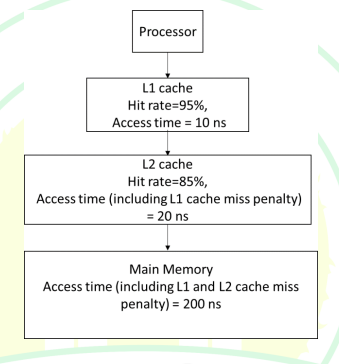
A computer has a memory hierarchy consisting of two-level cache (L1 and L2) and a main memory. If the processor needs to access data from memory, it first looks into L1 cache. If the data is not found in L1 cache, it goes to L2 cache. If it fails to get the data from L2 cache, it goes to main memory, where the data is definitely available. Hit rates and access times of various memory units are shown in the figure. The average memory access time in nanoseconds (ns) is ________. (rounded off to two decimal places)
Question figure
Show answer without attempting

Answer: 11.83 to 11.87

Q28

GATE CS 2025 CS-2Instruction Set and AddressingMSQ1 mark
Which of the following is/are part of an Instruction Set Architecture of a processor?
More than one option can be correct.
Show answer without attempting

Answer: D

Q39

GATE CS 2025 CS-2Memory HierarchyMCQ2 marks−2/3 if wrong
For a direct-mapped cache, 4 bits are used for the tag field and 12 bits are used to index into a cache block. The size of each cache block is one byte. Assume that there is no other information stored for each cache block.

Which ONE of the following is the CORRECT option for the sizes of the main memory and the cache memory in this system (byte addressable), respectively?
Show answer without attempting

Answer: A

Q55

GATE CS 2025 CS-2Memory HierarchyNAT2 marks
Given a computing system with two levels of cache (L1 and L2) and a main memory. The first level (L1) cache access time is 1 nanosecond (ns) and the “hit rate” for L1 cache is 90% while the processor is accessing the data from L1 cache. Whereas, for the second level (L2) cache, the “hit rate” is 80% and the “miss penalty” for transferring data from L2 cache to L1 cache is 10 ns. The “miss penalty” for the data to be transferred from main memory to L2 cache is 100 ns.

Then the average memory access time in this system in nanoseconds is ___________ . (rounded off to one decimal place)
Show answer without attempting

Answer: 4.0

Q56

GATE CS 2025 CS-2Instruction PipeliningNAT2 marks
A 5-stage instruction pipeline has stage delays of 180, 250, 150, 170, and 250, respectively, in nanoseconds. The delay of an inter-stage latch is 10 nanoseconds. Assume that there are no pipeline stalls due to branches and other hazards. The time taken to process 1000 instructions in microseconds is __________ . (rounded off to two decimal places)
Show answer without attempting

Answer: 260.20 to 261.20

Q61

GATE CS 2025 CS-2Instruction PipeliningNAT2 marks
An application executes 6.4×1086.4 \times 10^8 number of instructions in 6.3 seconds. There are four types of instructions, the details of which are given in the table. The duration of a clock cycle in nanoseconds is _________ . (rounded off to one decimal place)
Instruction typeClock cycles required per instruction (CPI)Number of instructions executed
Branch22.25×1082.25 \times 10^8
Load51.20×1081.20 \times 10^8
Store41.65×1081.65 \times 10^8
Arithmetic31.30×1081.30 \times 10^8
Show answer without attempting

Answer: 3.0

0/200 correct0 marks

Related topics in GATE CS