Computer Organization and Architecture questions

Q33

GATE CS 2023 CSInstruction PipeliningNAT1 mark
Consider a 3-stage pipelined processor having a delay of 10 ns (nanoseconds), 20 ns, and 14 ns, for the first, second, and the third stages, respectively. Assume that there is no other delay and the processor does not suffer from any pipeline hazards. Also assume that one instruction is fetched every cycle.

The total execution time for executing 100 instructions on this processor is ____________ ns.
Show answer without attempting

Answer: 2040
Q34

GATE CS 2023 CSInput OutputNAT1 mark
A keyboard connected to a computer is used at a rate of 1 keystroke per second. The computer system polls the keyboard every 10 ms (milliseconds) to check for a keystroke and consumes 100 μs (microseconds) for each poll. If it is determined after polling that a key has been pressed, the system consumes an additional 200 μs to process the keystroke. Let T1T_1 denote the fraction of a second spent in polling and processing a keystroke.

In an alternative implementation, the system uses interrupts instead of polling. An interrupt is raised for every keystroke. It takes a total of 1 ms for servicing an interrupt and processing a keystroke. Let T2T_2 denote the fraction of a second spent in servicing the interrupt and processing a keystroke.

The ratio T1T2\frac{T_1}{T_2} is ____________. (Rounded off to one decimal place)
Show answer without attempting

Answer: 10.2

Q41

GATE CS 2023 CSInstruction Set and AddressingMCQ2 marks−2/3 if wrong
Consider the given C-code and its corresponding assembly code, with a few operands U1–U4 being unknown. Some useful information as well as the semantics of each unique assembly instruction is annotated as inline comments in the code. The memory is byte-addressable.
//C-code
int a[10], b[10], i;
// int is 32-bit
for (i=0; i<10;i++)
a[i] = b[i] * 8;
;assembly-code (; indicates comments)
;r1-r5 are 32-bit integer registers
;initialize r1=0, r2=10
;initialize r3, r4 with base address of a, b
L01: jeq r1, r2, end ;if(r1==r2) goto end
L02: lw r5, 0(r4) ;r5 <- Memory[r4+0]
L03: shl r5, r5, U1 ;r5 <- r5 << U1
L04: sw r5, 0(r3) ;Memory[r3+0] <- r5
L05: add r3, r3, U2 ;r3 <- r3+U2
L06: add r4, r4, U3
L07: add r1, r1, 1
L08: jmp U4 ;goto U4
L09: end
Which one of the following options is a CORRECT replacement for operands in the position (U1, U2, U3, U4) in the above assembly code?
Show answer without attempting

Answer: B

Q42

GATE CS 2023 CSMemory HierarchyMCQ2 marks−2/3 if wrong
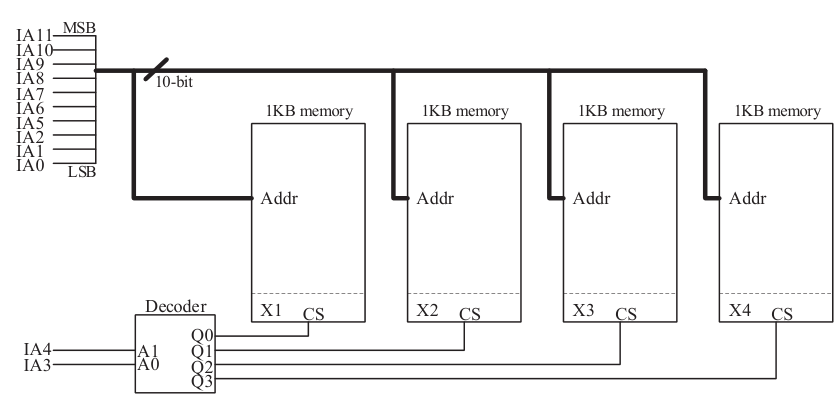
A 4 kilobyte (KB) byte-addressable memory is realized using four 1 KB memory blocks. Two input address lines (IA4 and IA3) are connected to the chip select (CS) port of these memory blocks through a decoder as shown in the figure. The remaining ten input address lines from IA11–IA0 are connected to the address port of these blocks. The chip select (CS) is active high.

The input memory addresses (IA11–IA0), in decimal, for the starting locations (Addr=0) of each block (indicated as X1, X2, X3, X4 in the figure) are among the options given below. Which one of the following options is CORRECT?
Question figure
Show answer without attempting

Answer: C

Q64

GATE CS 2023 CSMemory HierarchyNAT2 marks
An 8-way set associative cache of size 64 KB (1 KB=1024 bytes1 \text{ KB} = 1024 \text{ bytes}) is used in a system with 32-bit address. The address is sub-divided into TAG, INDEX, and BLOCK OFFSET.

The number of bits in the TAG is ____________.
Show answer without attempting

Answer: 19

0/50 correct0 marks

Related topics in GATE CS