Instruction Pipelining questions — page 1 of 2

Q16

GATE CS 2026 CS-1Instruction PipeliningMCQ1 mark−1/3 if wrong
Which one of the following dependencies among the register operands of different instructions can cause a data hazard in a pipelined processor?
Show answer without attempting

Answer: B

Q60

GATE CS 2026 CS-1Instruction PipeliningNAT2 marks
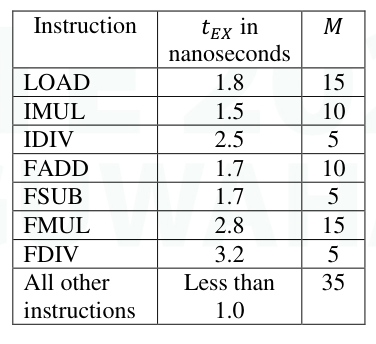
The EX stage of a pipelined processor performs the memory read operations for LOAD instructions, and the operations for the arithmetic and logic instructions. Let tEXt_{EX} denote the time taken by the EX stage to perform the operation for an instruction. For each instruction type, the values of tEXt_{EX} and MM (the number of instructions of that type in a sequence of 100 instructions for a program P), are given in the table below.

The duration of the pipeline clock cycle is 1 nanosecond. Assume that the latch time for the interstage buffers in the pipeline is negligible.

When program P is executed, the number of clock cycles for which the pipeline is stalled due to structural hazards in the EX stage is ______. (answer in integer)
Question figure
Show answer without attempting

Answer: 95

Q57

GATE CS 2026 CS-2Instruction PipeliningNAT2 marks
A non-pipelined instruction execution unit that operates at 1.6 GHz clock takes an average of 5 clock cycles to complete the execution of an instruction. To improve the performance, the system was pipelined with a goal of achieving an average throughput of one instruction per clock cycle. However, it could operate only at 1.2 GHz due to pipeline overheads. While executing a program in the pipelined design, 30% of instructions encountered a stall of 2 cycles due to pipeline hazards. The speed-up obtained by the pipelined design over the non-pipelined one for this program is ___________. (rounded off to two decimal places)

Note: 1G=1091\text{G}=10^9
Show answer without attempting

Answer: 2.30 to 2.40

Q56

GATE CS 2025 CS-2Instruction PipeliningNAT2 marks
A 5-stage instruction pipeline has stage delays of 180, 250, 150, 170, and 250, respectively, in nanoseconds. The delay of an inter-stage latch is 10 nanoseconds. Assume that there are no pipeline stalls due to branches and other hazards. The time taken to process 1000 instructions in microseconds is __________ . (rounded off to two decimal places)
Show answer without attempting

Answer: 260.20 to 261.20

Q61

GATE CS 2025 CS-2Instruction PipeliningNAT2 marks
An application executes 6.4×1086.4 \times 10^8 number of instructions in 6.3 seconds. There are four types of instructions, the details of which are given in the table. The duration of a clock cycle in nanoseconds is _________ . (rounded off to one decimal place)
Instruction typeClock cycles required per instruction (CPI)Number of instructions executed
Branch22.25×1082.25 \times 10^8
Load51.20×1081.20 \times 10^8
Store41.65×1081.65 \times 10^8
Arithmetic31.30×1081.30 \times 10^8
Show answer without attempting

Answer: 3.0

Q30

GATE CS 2024 CS-1Instruction PipeliningMSQ1 mark
Consider a 5-stage pipelined processor with Instruction Fetch (IF), Instruction Decode (ID), Execute (EX), Memory Access (MEM), and Register Writeback (WB) stages. Which of the following statements about forwarding is/are CORRECT?
More than one option can be correct.
Show answer without attempting

Answer: A, B, C

Q55

GATE CS 2024 CS-1Instruction PipeliningNAT2 marks
The baseline execution time of a program on a 2 GHz single core machine is 100 nanoseconds (ns). The code corresponding to 90% of the execution time can be fully parallelized. The overhead for using an additional core is 10 ns when running on a multicore system. Assume that all cores in the multicore system run their share of the parallelized code for an equal amount of time.
The number of cores that minimize the execution time of the program is ________
Show answer without attempting

Answer: 3

Q31

GATE CS 2024 CS-2Instruction PipeliningMSQ1 mark
An instruction format has the following structure:
Instruction Number: Opcode destination reg, source reg-1, source reg-2

Consider the following sequence of instructions to be executed in a pipelined processor:

I1: DIV R3, R1, R2
I2: SUB R5, R3, R4
I3: ADD R3, R5, R6
I4: MUL R7, R3, R8

Which of the following statements is/are TRUE?
More than one option can be correct.
Show answer without attempting

Answer: A

Q58

GATE CS 2024 CS-2Instruction PipeliningNAT2 marks
A non-pipelined instruction execution unit operating at 2 GHz takes an average of 6 cycles to execute an instruction of a program P. The unit is then redesigned to operate on a 5-stage pipeline at 2 GHz. Assume that the ideal throughput of the pipelined unit is 1 instruction per cycle. In the execution of program P, 20% instructions incur an average of 2 cycles stall due to data hazards and 20% instructions incur an average of 3 cycles stall due to control hazards. The speedup (rounded off to one decimal place) obtained by the pipelined design over the non-pipelined design is _________
Show answer without attempting

Answer: 2.9 to 3.1

Q33

GATE CS 2023 CSInstruction PipeliningNAT1 mark
Consider a 3-stage pipelined processor having a delay of 10 ns (nanoseconds), 20 ns, and 14 ns, for the first, second, and the third stages, respectively. Assume that there is no other delay and the processor does not suffer from any pipeline hazards. Also assume that one instruction is fetched every cycle.

The total execution time for executing 100 instructions on this processor is ____________ ns.
Show answer without attempting

Answer: 2040

Q61

GATE CS 2022 CSInstruction PipeliningNAT2 marks
A processor X1X_1 operating at 2 GHz has a standard 5-stage RISC instruction pipeline having a base CPI (cycles per instruction) of one without any pipeline hazards. For a given program PP that has 30% branch instructions, control hazards incur 2 cycles stall for every branch. A new version of the processor X2X_2 operating at same clock frequency has an additional branch predictor unit (BPU) that completely eliminates stalls for correctly predicted branches. There is neither any savings nor any additional stalls for wrong predictions. There are no structural hazards and data hazards for X1X_1 and X2X_2. If the BPU has a prediction accuracy of 80%, the speed up (rounded off to two decimal places) obtained by X2X_2 over X1X_1 in executing PP is____________.
Show answer without attempting

Answer: 1.42 to 1.45

Q53

GATE CS 2021 CS-1Instruction PipeliningNAT2 marks
A five-stage pipeline has stage delays of 150, 120, 150, 160 and 140 nanoseconds. The registers that are used between the pipeline stages have a delay of 5 nanoseconds each.
The total time to execute 100 independent instructions on this pipeline, assuming there are no pipeline stalls, is ______ nanoseconds.
Show answer without attempting

Answer: 17160

Q53

GATE CS 2021 CS-2Instruction PipeliningNAT2 marks
Consider a pipelined processor with 5 stages, Instruction Fetch (IF), Instruction Decode (ID), Execute (EX), Memory Access (MEM), and Write Back (WB). Each stage of the pipeline, except the EX stage, takes one cycle. Assume that the ID stage merely decodes the instruction and the register read is performed in the EX stage. The EX stage takes one cycle for ADD instruction and two cycles for MUL instruction. Ignore pipeline register latencies.
Consider the following sequence of 8 instructions:

ADD, MUL, ADD, MUL, ADD, MUL, ADD, MUL

Assume that every MUL instruction is data-dependent on the ADD instruction just before it and every ADD instruction (except the first ADD) is data-dependent on the MUL instruction just before it. The Speedup is defined as follows:

Speedup=Execution time without operand forwardingExecution time with operand forwarding\text{Speedup} = \frac{\text{Execution time without operand forwarding}}{\text{Execution time with operand forwarding}}

The Speedup achieved in executing the given instruction sequence on the pipelined processor (rounded to 2 decimal places) is ____________.
Show answer without attempting

Answer: 1.87 to 1.88

Q43

GATE CS 2020 CSInstruction PipeliningNAT2 marks
Consider a non-pipelined processor operating at 2.5 GHz. It takes 5 clock cycles to complete an instruction. You are going to make a 5-stage pipeline out of this processor. Overheads associated with pipelining force you to operate the pipelined processor at 2 GHz. In a given program, assume that 30% are memory instructions, 60% are ALU instructions and the rest are branch instructions. 5% of the memory instructions cause stalls of 50 clock cycles each due to cache misses and 50% of the branch instructions cause stalls of 2 cycles each. Assume that there are no stalls associated with the execution of ALU instructions. For this program, the speedup achieved by the pipelined processor over the non-pipelined processor (round off to 2 decimal places) is __________.
Show answer without attempting

Answer: 2.15 to 2.18

Q50

GATE CS 2018 CSInstruction PipeliningNAT2 marks
The instruction pipeline of a RISC processor has the following stages: Instruction Fetch (IF), Instruction Decode (ID), Operand Fetch (OF), Perform Operation (PO) and Writeback (WB). The IF, ID, OF and WB stages take 1 clock cycle each for every instruction. Consider a sequence of 100 instructions. In the PO stage, 40 instructions take 3 clock cycles each, 35 instructions take 2 clock cycles each, and the remaining 25 instructions take 1 clock cycle each. Assume that there are no data hazards and no control hazards.

The number of clock cycles required for completion of execution of the sequence of instructions is ______.
Show answer without attempting

Answer: 219

Q50

GATE CS 2017 CS-1Instruction PipeliningNAT2 marks
Instruction execution in a processor is divided into 55 stages, Instruction Fetch (IF), Instruction Decode (ID), Operand Fetch (OF), Execute (EX), and Write Back (WB). These stages take 5,4,20,10,5, 4, 20, 10, and 33 nanoseconds (ns) respectively. A pipelined implementation of the processor requires buffering between each pair of consecutive stages with a delay of 2 ns2\text{ ns}. Two pipelined implementations of the processor are contemplated:

(i) a naive pipeline implementation (NP) with 55 stages and
(ii) an efficient pipeline (EP) where the OF stage is divided into stages OF1 and OF2 with execution times of 12 ns12\text{ ns} and 8 ns8\text{ ns} respectively.

The speedup (correct to two decimal places) achieved by EP over NP in executing 2020 independent instructions with no hazards is ____________.
Show answer without attempting

Answer: 1.49 to 1.52

Q32

GATE CS 2016 CS-1Instruction PipeliningNAT2 marks
The stage delays in a 4-stage pipeline are 800, 500, 400 and 300 picoseconds. The first stage (with delay 800 picoseconds) is replaced with a functionally equivalent design involving two stages with respective delays 600 and 350 picoseconds. The throughput increase of the pipeline is ________ percent.
Show answer without attempting

Answer: 33.0 to 34.0

Q30

GATE CS 2016 CS-2Instruction PipeliningNAT2 marks
Suppose the functions FF and GG can be computed in 5 and 3 nanoseconds by functional units UFU_F and UGU_G, respectively. Given two instances of UFU_F and two instances of UGU_G, it is required to implement the computation F(G(Xi))F(G(X_i)) for 1≤i≤101 \le i \le 10. Ignoring all other delays, the minimum time required to complete this computation is _________ nanoseconds.
Show answer without attempting

Answer: 28.0

Q33

GATE CS 2016 CS-2Instruction PipeliningNAT2 marks
Consider a 3 GHz (gigahertz) processor with a three-stage pipeline and stage latencies τ1\tau_1, τ2\tau_2, and τ3\tau_3 such that τ1=3τ2/4=2τ3\tau_1 = 3\tau_2 / 4 = 2\tau_3. If the longest pipeline stage is split into two pipeline stages of equal latency, the new frequency is _________ GHz, ignoring delays in the pipeline registers.
Show answer without attempting

Answer: 3.9 to 4.1

Q48

GATE CS 2015 CS-3Instruction PipeliningNAT2 marks
Consider the following reservation table for a pipeline having three stages S1S_1, S2S_2 and S3S_3.
Time →\to12345
S1S_1XX
S2S_2XX
S3S_3X
The minimum average latency (MAL) is ____________.
Show answer without attempting

Answer: 3

0/200 correct0 marks

Related topics in Computer Organization and Architecture