Instruction Pipelining questions

Q16

GATE CS 2026 CS-1Instruction PipeliningMCQ1 mark−1/3 if wrong
Which one of the following dependencies among the register operands of different instructions can cause a data hazard in a pipelined processor?
Show answer without attempting

Answer: B

Q60

GATE CS 2026 CS-1Instruction PipeliningNAT2 marks
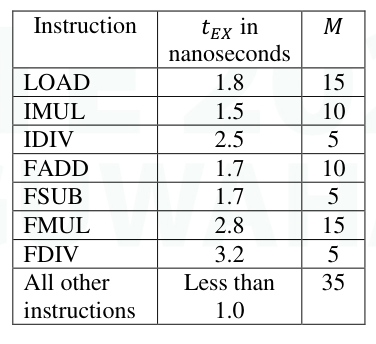
The EX stage of a pipelined processor performs the memory read operations for LOAD instructions, and the operations for the arithmetic and logic instructions. Let tEXt_{EX} denote the time taken by the EX stage to perform the operation for an instruction. For each instruction type, the values of tEXt_{EX} and MM (the number of instructions of that type in a sequence of 100 instructions for a program P), are given in the table below.

The duration of the pipeline clock cycle is 1 nanosecond. Assume that the latch time for the interstage buffers in the pipeline is negligible.

When program P is executed, the number of clock cycles for which the pipeline is stalled due to structural hazards in the EX stage is ______. (answer in integer)
Question figure
Show answer without attempting

Answer: 95

Q57

GATE CS 2026 CS-2Instruction PipeliningNAT2 marks
A non-pipelined instruction execution unit that operates at 1.6 GHz clock takes an average of 5 clock cycles to complete the execution of an instruction. To improve the performance, the system was pipelined with a goal of achieving an average throughput of one instruction per clock cycle. However, it could operate only at 1.2 GHz due to pipeline overheads. While executing a program in the pipelined design, 30% of instructions encountered a stall of 2 cycles due to pipeline hazards. The speed-up obtained by the pipelined design over the non-pipelined one for this program is ___________. (rounded off to two decimal places)

Note: 1G=1091\text{G}=10^9
Show answer without attempting

Answer: 2.30 to 2.40

0/30 correct0 marks

Related topics in Computer Organization and Architecture