Computer Organization and Architecture questions

Q11

GATE CS 2025 CS-1Input OutputMCQ1 mark−1/3 if wrong
Suppose a program is running on a non-pipelined single processor computer system. The computer is connected to an external device that can interrupt the processor asynchronously. The processor needs to execute the interrupt service routine (ISR) to serve this interrupt. The following steps (not necessarily in order) are taken by the processor when the interrupt arrives:
(i) The processor saves the content of the program counter.
(ii) The program counter is loaded with the start address of the ISR.
(iii) The processor finishes the present instruction.
Which ONE of the following is the CORRECT sequence of steps?
Show answer without attempting

Answer: A
Q27

GATE CS 2025 CS-1Instruction Set and AddressingMSQ1 mark
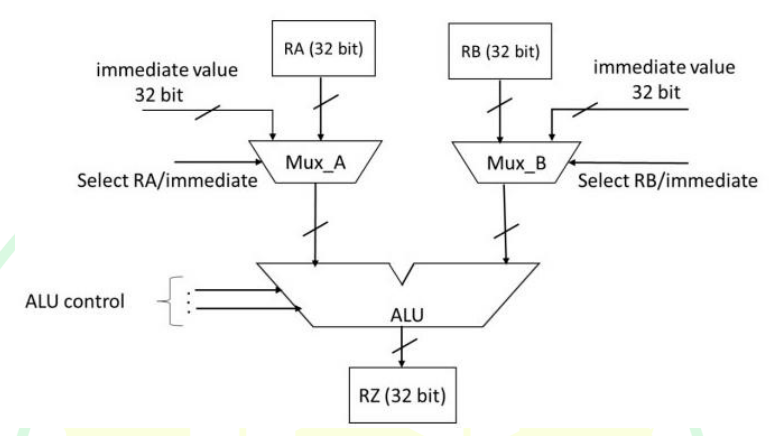
A partial data path of a processor is given in the figure, where RA, RB, and RZ are 32-bit registers. Which option(s) is/are CORRECT related to arithmetic operations using the data path as shown?
Question figure
More than one option can be correct.
Show answer without attempting

Answer: A, B, C

Q36

GATE CS 2025 CS-1Memory HierarchyMCQ2 marks−2/3 if wrong
Consider a memory system with 1M bytes of main memory and 16K bytes of cache memory. Assume that the processor generates 20-bit memory address, and the cache block size is 16 bytes. If the cache uses direct mapping, how many bits will be required to store all the tag values? [Assume memory is byte addressable, 1K=2101\text{K}=2^{10}, 1M=2201\text{M}=2^{20}.]
Show answer without attempting

Answer: A
Q37

GATE CS 2025 CS-1Instruction Set and AddressingMCQ2 marks−2/3 if wrong
A processor has 64 general-purpose registers and 50 distinct instruction types. An instruction is encoded in 32-bits. What is the maximum number of bits that can be used to store the immediate operand for the given instruction?
ADD R1, #25 // R1 = R1 + 25
Show answer without attempting

Answer: B

Q53

GATE CS 2025 CS-1Memory HierarchyNAT2 marks
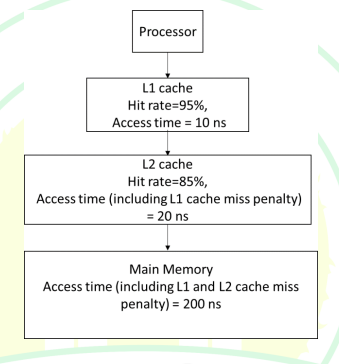
A computer has a memory hierarchy consisting of two-level cache (L1 and L2) and a main memory. If the processor needs to access data from memory, it first looks into L1 cache. If the data is not found in L1 cache, it goes to L2 cache. If it fails to get the data from L2 cache, it goes to main memory, where the data is definitely available. Hit rates and access times of various memory units are shown in the figure. The average memory access time in nanoseconds (ns) is ________. (rounded off to two decimal places)
Question figure
Show answer without attempting

Answer: 11.83 to 11.87

Q28

GATE CS 2025 CS-2Instruction Set and AddressingMSQ1 mark
Which of the following is/are part of an Instruction Set Architecture of a processor?
More than one option can be correct.
Show answer without attempting

Answer: D

Q39

GATE CS 2025 CS-2Memory HierarchyMCQ2 marks−2/3 if wrong
For a direct-mapped cache, 4 bits are used for the tag field and 12 bits are used to index into a cache block. The size of each cache block is one byte. Assume that there is no other information stored for each cache block.

Which ONE of the following is the CORRECT option for the sizes of the main memory and the cache memory in this system (byte addressable), respectively?
Show answer without attempting

Answer: A

Q55

GATE CS 2025 CS-2Memory HierarchyNAT2 marks
Given a computing system with two levels of cache (L1 and L2) and a main memory. The first level (L1) cache access time is 1 nanosecond (ns) and the “hit rate” for L1 cache is 90% while the processor is accessing the data from L1 cache. Whereas, for the second level (L2) cache, the “hit rate” is 80% and the “miss penalty” for transferring data from L2 cache to L1 cache is 10 ns. The “miss penalty” for the data to be transferred from main memory to L2 cache is 100 ns.

Then the average memory access time in this system in nanoseconds is ___________ . (rounded off to one decimal place)
Show answer without attempting

Answer: 4.0

Q56

GATE CS 2025 CS-2Instruction PipeliningNAT2 marks
A 5-stage instruction pipeline has stage delays of 180, 250, 150, 170, and 250, respectively, in nanoseconds. The delay of an inter-stage latch is 10 nanoseconds. Assume that there are no pipeline stalls due to branches and other hazards. The time taken to process 1000 instructions in microseconds is __________ . (rounded off to two decimal places)
Show answer without attempting

Answer: 260.20 to 261.20

Q61

GATE CS 2025 CS-2Instruction PipeliningNAT2 marks
An application executes 6.4×1086.4 \times 10^8 number of instructions in 6.3 seconds. There are four types of instructions, the details of which are given in the table. The duration of a clock cycle in nanoseconds is _________ . (rounded off to one decimal place)
Instruction typeClock cycles required per instruction (CPI)Number of instructions executed
Branch22.25×1082.25 \times 10^8
Load51.20×1081.20 \times 10^8
Store41.65×1081.65 \times 10^8
Arithmetic31.30×1081.30 \times 10^8
Show answer without attempting

Answer: 3.0

0/100 correct0 marks

Related topics in GATE CS