Computer Organization and Architecture questions

Q14

GATE CS 2026 CS-1Instruction Set and AddressingMCQ1 mark−1/3 if wrong
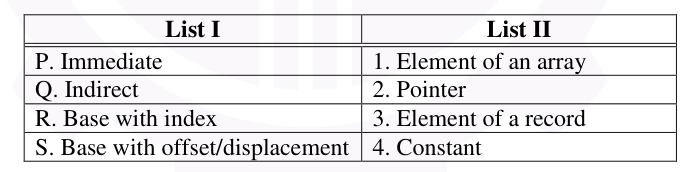
Match each addressing mode in List I with a data element or an element of a data structure (in a high-level language) in List II:

List I
P. Immediate
Q. Indirect
R. Base with index
S. Base with offset/displacement

List II
1. Element of an array
2. Pointer
3. Element of a record
4. Constant
Question figure
Show answer without attempting

Answer: B
Q15

GATE CS 2026 CS-1Instruction Set and AddressingMCQ1 mark−1/3 if wrong
Consider a processor P whose instruction set architecture is the load-store architecture. The instruction format is such that the first operand of any instruction is the destination operand.

Which one of the following sequences of instructions corresponds to the high-level language statement Z = X + Y ?

Note: X, Y, and Z are memory operands. R0, R1, and R2 are registers.
Show answer without attempting

Answer: D

Q16

GATE CS 2026 CS-1Instruction PipeliningMCQ1 mark−1/3 if wrong
Which one of the following dependencies among the register operands of different instructions can cause a data hazard in a pipelined processor?
Show answer without attempting

Answer: B

Q38

GATE CS 2026 CS-1Memory HierarchyMCQ2 marks−2/3 if wrong
The size of the physical address space of a processor is 2322^{32} bytes. The capacity of a cache memory unit is 2232^{23} bytes. The cache block size is 128 bytes. The cache memory unit can be built as a direct mapped cache or as a KK-way set-associative cache, where K=2LK = 2^L and L∈{1,2,3}L \in \{1, 2, 3\}. Let the length of the TAG field be MM bits for the direct mapped cache, and NN bits for the set-associative cache.

Which one of the following options is true?
Show answer without attempting

Answer: A

Q60

GATE CS 2026 CS-1Instruction PipeliningNAT2 marks
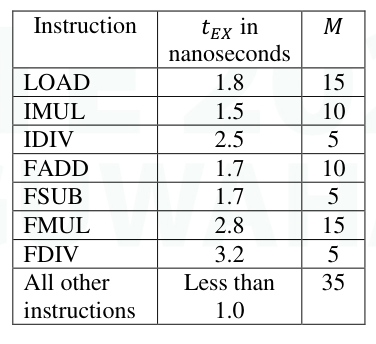
The EX stage of a pipelined processor performs the memory read operations for LOAD instructions, and the operations for the arithmetic and logic instructions. Let tEXt_{EX} denote the time taken by the EX stage to perform the operation for an instruction. For each instruction type, the values of tEXt_{EX} and MM (the number of instructions of that type in a sequence of 100 instructions for a program P), are given in the table below.

The duration of the pipeline clock cycle is 1 nanosecond. Assume that the latch time for the interstage buffers in the pipeline is negligible.

When program P is executed, the number of clock cycles for which the pipeline is stalled due to structural hazards in the EX stage is ______. (answer in integer)
Question figure
Show answer without attempting

Answer: 95

Q18

GATE CS 2026 CS-2Input OutputMCQ1 mark−1/3 if wrong
Consider the following two statements about interrupt handling mechanisms in a CPU.

S1: In non-vectored interrupt mechanism, it usually takes more time to start the Interrupt Service Routine (ISR) when compared to that in a vectored interrupt mechanism.

S2: In daisy-chain interrupt mechanism, the CPU polls all the input devices individually to determine the source of the interrupt.

Which one of the following options is correct with respect to S1 and S2 ?
Show answer without attempting

Answer: C

Q44

GATE CS 2026 CS-2Instruction Set and AddressingMCQ2 marks−2/3 if wrong
Consider a processor that has 16 general purpose registers and it uses 2-byte instruction format for all its instructions. Variable-sized opcodes are permitted. There are three different types of instructions; M-type, R-type, and C-type. Each M-type instruction has 2 register operands and a 6-bit immediate operand. Each R-type instruction has 3 register operands. Each C-type instruction has a register operand and a 6-bit offset value. If there are 2 unique M-type opcodes and 7 unique R-type opcodes, which one of the following options gives the maximum number of unique opcodes possible for C-type instructions?
Show answer without attempting

Answer: B

Q52

GATE CS 2026 CS-2Memory HierarchyMSQ2 marks
Consider a system with a processor and a 4 KB direct mapped cache with block size of 16 bytes. The system has a 16 MB physical memory. Four words P, Q, R, and S are accessed by the processor in the same order 10 times. That is, there are a total of 40 memory references in the sequence P, Q, R, S, P, Q, R, S,…

Assume that the cache memory is initially empty. The physical addresses of the words are given below (1 word = 1 byte).

P: 0x845B32, Q: 0x845B26, R: 0x845B36, S: 0x846B32

Which of the following statements is/are true?

Note: 1K=2101\text{K}=2^{10} and 1M=2201\text{M}=2^{20}
More than one option can be correct.
Show answer without attempting

Answer: A, B

Q56

GATE CS 2026 CS-2Memory HierarchyNAT2 marks
Consider a system with 1 MB physical memory and a word length of 1 byte. The system uses a direct mapped cache, with block numbers starting from 0. The word with physical address 0xA2C28 is mapped to the cache block number 17610176_{10}. The maximum possible size of the cache (in KB) for this configuration is ___________. (answer in integer)

Note: 1K=2101\text{K}=2^{10} and 1M=2201\text{M}=2^{20}
Show answer without attempting

Answer: 128

Q57

GATE CS 2026 CS-2Instruction PipeliningNAT2 marks
A non-pipelined instruction execution unit that operates at 1.6 GHz clock takes an average of 5 clock cycles to complete the execution of an instruction. To improve the performance, the system was pipelined with a goal of achieving an average throughput of one instruction per clock cycle. However, it could operate only at 1.2 GHz due to pipeline overheads. While executing a program in the pipelined design, 30% of instructions encountered a stall of 2 cycles due to pipeline hazards. The speed-up obtained by the pipelined design over the non-pipelined one for this program is ___________. (rounded off to two decimal places)

Note: 1G=1091\text{G}=10^9
Show answer without attempting

Answer: 2.30 to 2.40

0/100 correct0 marks

Related topics in GATE CS