Instruction Set and Addressing questions

Q14

GATE CS 2026 CS-1Instruction Set and AddressingMCQ1 mark−1/3 if wrong
Match each addressing mode in List I with a data element or an element of a data structure (in a high-level language) in List II:

List I
P. Immediate
Q. Indirect
R. Base with index
S. Base with offset/displacement

List II
1. Element of an array
2. Pointer
3. Element of a record
4. Constant
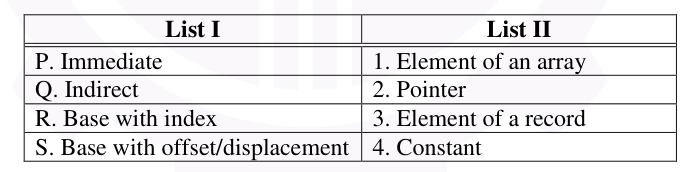
Question figure
Show answer without attempting

Answer: B

Q15

GATE CS 2026 CS-1Instruction Set and AddressingMCQ1 mark−1/3 if wrong
Consider a processor P whose instruction set architecture is the load-store architecture. The instruction format is such that the first operand of any instruction is the destination operand.

Which one of the following sequences of instructions corresponds to the high-level language statement Z = X + Y ?

Note: X, Y, and Z are memory operands. R0, R1, and R2 are registers.
Show answer without attempting

Answer: D

Q44

GATE CS 2026 CS-2Instruction Set and AddressingMCQ2 marks−2/3 if wrong
Consider a processor that has 16 general purpose registers and it uses 2-byte instruction format for all its instructions. Variable-sized opcodes are permitted. There are three different types of instructions; M-type, R-type, and C-type. Each M-type instruction has 2 register operands and a 6-bit immediate operand. Each R-type instruction has 3 register operands. Each C-type instruction has a register operand and a 6-bit offset value. If there are 2 unique M-type opcodes and 7 unique R-type opcodes, which one of the following options gives the maximum number of unique opcodes possible for C-type instructions?
Show answer without attempting

Answer: B

0/30 correct0 marks

Related topics in Computer Organization and Architecture