Programming and Data Structures questions

Q15

GATE CS 2022 CSLinear Data StructuresMCQ1 mark−1/3 if wrong
Consider the problem of reversing a singly linked list. To take an example, given the linked list below,

head -> [a] -> [b] -> [c] -> [d] -> [e] -> NULL

the reversed linked list should look like

head -> [e] -> [d] -> [c] -> [b] -> [a] -> NULL

Which one of the following statements is TRUE about the time complexity of algorithms that solve the above problem in O(1)O(1) space?
Show answer without attempting

Answer: A
Q21

GATE CS 2022 CSC ProgrammingMCQ1 mark−1/3 if wrong
What is printed by the following ANSI C program?
#include<stdio.h>
int main(int argc, char *argv[])
{
  int x = 1, z[2] = {10, 11};
  int *p = NULL;
  p = &x;
  *p = 10;
  p = &z[1];
  *(&z[0] + 1) += 3;
  printf("%d, %d, %d\n", x, z[0], z[1]);
  return 0;
}
Show answer without attempting

Answer: D

Q28

GATE CS 2022 CSTree Data StructuresNAT1 mark
Suppose a binary search tree with 1000 distinct elements is also a complete binary tree. The tree is stored using the array representation of binary heap trees. Assuming that the array indices start with 0, the 3rd3^{\text{rd}} largest element of the tree is stored at index_____________
Show answer without attempting

Answer: 509

Q43

GATE CS 2022 CSC ProgrammingMCQ2 marks−2/3 if wrong
What is printed by the following ANSI C program?
#include<stdio.h>
int main(int argc, char *argv[])
{
  int a[3][3][3] =
  {{1, 2, 3, 4, 5, 6, 7, 8, 9},
   {10, 11, 12, 13, 14, 15, 16, 17, 18},
   {19, 20, 21, 22, 23, 24, 25, 26, 27}};
  int i = 0, j = 0, k = 0;
  for( i = 0; i < 3; i++ ){
    for(k = 0; k < 3; k++ )
      printf("%d ", a[i][j][k]);
    printf("\n");
  }
  return 0;
}
Show answer without attempting

Answer: A
Q44

GATE CS 2022 CSC ProgrammingMCQ2 marks−2/3 if wrong
What is printed by the following ANSI C program?
#include<stdio.h>
int main(int argc, char *argv[]){
  char a = 'P';
  char b = 'x';
  char c = (a & b) + '*';
  char d = (a | b) - '-';
  char e = (a ^ b) + '+';
  printf("%c %c %c\n", c, d, e);
  return 0;
}
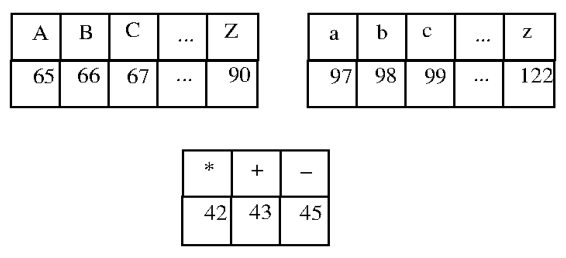
ASCII encoding for relevant characters is given below
Question figure
Show answer without attempting

Answer: A

Q62

GATE CS 2022 CSLinear Data StructuresNAT2 marks
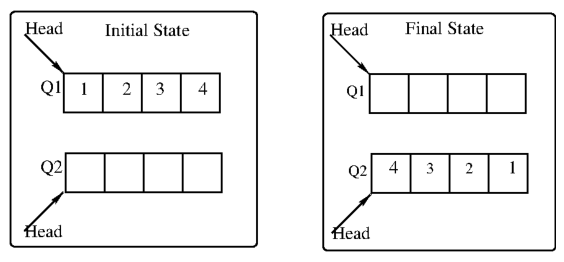
Consider the queues Q1Q_1 containing four elements and Q2Q_2 containing none (shown as the Initial State in the figure). The only operations allowed on these two queues are Enqueue(Q, element) and Dequeue(Q). The minimum number of Enqueue operations on Q1Q_1 required to place the elements of Q1Q_1 in Q2Q_2 in reverse order (shown as the Final State in the figure) without using any additional storage is___________.
Question figure
Show answer without attempting

Answer: 0

0/60 correct0 marks

Related topics in GATE CS