Q26
Which of the following statement(s) is/are TRUE for any binary search tree (BST) having distinct integers?
More than one option can be correct.
Show answer without attempting
Answer: A, B
GATE CS · 14 questions
14 Programming and Data Structures questions from GATE CS papers (2025), each with the official answer key. Answer any question right here and it is marked straight away, or practise them one at a time.
Answer: A, B
#include <stdio.h>
void foo(int *p, int x){
 *p=x;
}
int main(){
 int *z;
 int a = 20, b = 25;
 z = &a;
 foo(z,b);
 printf("%d",a);
 return 0;
}Answer: 25
Answer: 5
#include <stdio.h>
int foo(int S[],int size){
 if(size == 0) return 0;
 if(size == 1) return 1;
 if(S[0] != S[1]) return 1+foo(S+1,size-1);
 return foo(S+1,size-1);
}
int main(){
 int A[]={0,1,2,2,2,0,0,1,1};
 printf("%d",foo(A,9));
 return 0;
}Answer: 5
typedef struct list {
 int data;
 struct list *next;
} LIST;int find (int query, LIST *list) {
while (list != NULL){
if(list->data == query) return 1;
list = list->next;
}
return 0;
}
int main () {
ptr1=L1; ptr2=L2;
while (ptr1->next != NULL){
query = ptr1->next->data;
if (find (query, L2))
ptr1->next = ptr1->next->next;
else ptr1 = ptr1->next;
}
return 0;
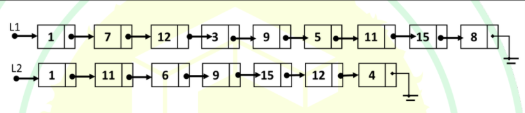
}
Answer: 5
#include <stdio.h>
int gate (int n) {
 int d, t, newnum, turn;
 newnum = turn = 0; t=1;
 while (n>=t) t *= 10;
 t /=10;
 while (t>0) {
 d = n/t;
 n = n%t;
 t /= 10;
 if (turn) newnum = 10*newnum + d;
 turn = (turn + 1) % 2;
 }
 return newnum;
}
int main () {
 printf ("%d", gate(14362));
 return 0;
}Answer: 46
Answer: B
#include <stdio.h>
void stringcopy(char *, char *);
int main(){
    char a[30] = "@#Hello World!";
    stringcopy(a, a + 2);
    printf("%s\n", a);
    return 0;
}
void stringcopy(char *s, char *t) {
    while(*t)
        *s++ = *t++;
}Answer: D
 int x=126,y=105;
 do {
 if(x>y) x=x-y;
 else y=y-x;
 } while(x!=y);
printf("%d",x);Answer: 21
Answer: 4
Answer: A
Answer: A
#include <stdio.h>
int main(){
    int a;
    int arr[5] = {30,50,10};
    int *ptr;
    ptr = &arr[0] + 1;
    a = *ptr;
    (*ptr)++;
    ptr++;
    printf("%d", a + (*ptr) + arr[1]);
    return 0;
}Answer: 111
#include <stdio.h>
int g(int n) {
    return (n+10);
}
int f(int n) {
    return g(n*2);
}
int main() {
    int sum, n;
    sum=0;
    for (n=1; n<3; n++)
        sum += g(f(n));
    printf ("%d", sum);
    return 0;
}Answer: 46
0/140 correct0 marks