Theory of Computation questions — page 6 of 7

Q60

GATE CS 2015 CS-2Regular LanguagesMCQ2 marks−2/3 if wrong
Consider the alphabet Σ={0,1}\Sigma = \{0, 1\}, the null/empty string λ\lambda and the sets of strings X0X_0, X1X_1, and X2X_2 generated by the corresponding non-terminals of a regular grammar. X0X_0, X1X_1, and X2X_2 are related as follows.

X0=1X1X_0 = 1 X_1
X1=0X1+1X2X_1 = 0 X_1 + 1 X_2
X2=0X1+{λ}X_2 = 0 X_1 + \{\lambda\}

Which one of the following choices precisely represents the strings in X0X_0?
Show answer without attempting

Answer: C
Q15

GATE CS 2014 CS-2Regular LanguagesMCQ1 mark−1/3 if wrong
If L1={an∣n≥0}L_1 = \{a^n \mid n \geq 0\} and L2={bn∣n≥0}L_2 = \{b^n \mid n \geq 0\}, consider

(I) L1⋅L2L_1 \cdot L_2 is a regular language
(II) L1⋅L2={anbn∣n≥0}L_1 \cdot L_2 = \{a^n b^n \mid n \geq 0\}

Which one of the following is CORRECT?
Show answer without attempting

Answer: A

Q16

GATE CS 2014 CS-2ComputabilityMCQ1 mark−1/3 if wrong
Let A≤mBA \leq_m B denotes that language A is mapping reducible (also known as many-to-one reducible) to language B. Which one of the following is FALSE?
Show answer without attempting

Answer: D

Q35

GATE CS 2014 CS-2ComputabilityMCQ2 marks−2/3 if wrong
Let ⟨M⟩\langle M \rangle be the encoding of a Turing machine as a string over Σ={0,1}\Sigma = \{0, 1\}. Let L={⟨M⟩∣M is a Turing machine that accepts a string of length 2014}L = \{ \langle M \rangle \mid M \text{ is a Turing machine that accepts a string of length } 2014 \}. Then, LL is
Show answer without attempting

Answer: B

Q36

GATE CS 2014 CS-2Regular LanguagesMCQ2 marks−2/3 if wrong
Let L1={w∈{0,1}∗∣w has at least as many occurrences of (110)’s as (011)’s}L_1 = \{w \in \{0,1\}^* \mid w \text{ has at least as many occurrences of (110)'s as (011)'s}\}. Let L2={w∈{0,1}∗∣w has at least as many occurrences of (000)’s as (111)’s}L_2 = \{w \in \{0,1\}^* \mid w \text{ has at least as many occurrences of (000)'s as (111)'s}\}. Which one of the following is TRUE?
Show answer without attempting

Answer: A

Q15

GATE CS 2014 CS-3Regular LanguagesNAT1 mark
The length of the shortest string NOT in the language (over Σ={a,b}\Sigma = \{a, b\}) of the following regular expression is ______________.

a∗b∗(ba)∗a∗a^*b^*(ba)^*a^*
Show answer without attempting

Answer: 3

Q35

GATE CS 2014 CS-3ComputabilityMCQ2 marks−2/3 if wrong
Which one of the following problems is undecidable?
Show answer without attempting

Answer: A

Q36

GATE CS 2014 CS-3Context Free LanguagesMCQ2 marks−2/3 if wrong
Consider the following languages over the alphabet Σ={0,1,c}\Sigma = \{0, 1, c\}:

L1={0n1n∣n≥0}L_1 = \{0^n1^n \mid n \ge 0\}
L2={wcwr∣w∈{0,1}∗}L_2 = \{wcw^r \mid w \in \{0, 1\}^*\}
L3={wwr∣w∈{0,1}∗}L_3 = \{ww^r \mid w \in \{0, 1\}^*\}

Here, wrw^r is the reverse of the string ww. Which of these languages are deterministic Context-free languages?
Show answer without attempting

Answer: C
Q15

GATE CS 2014 CS-1Regular LanguagesMCQ1 mark−1/3 if wrong
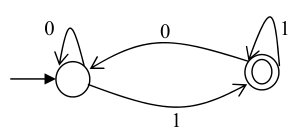
Which one of the following is TRUE?
Show answer without attempting

Answer: C
Q16

GATE CS 2014 CS-1Regular LanguagesMCQ1 mark−1/3 if wrong
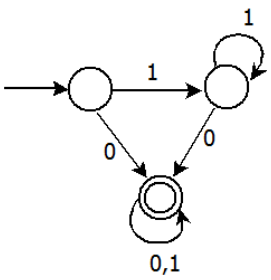
Consider the finite automaton in the following figure.

What is the set of reachable states for the input string 0011?
Question figure
Show answer without attempting

Answer: A

Q35

GATE CS 2014 CS-1ComputabilityMCQ2 marks−2/3 if wrong
Let LL be a language and Lˉ\bar{L} be its complement. Which one of the following is NOT a viable possibility?
Show answer without attempting

Answer: C
Q36

GATE CS 2014 CS-1Regular LanguagesMCQ2 marks−2/3 if wrong
Which of the regular expressions given below represent the following DFA?

I) 0∗1(1+00∗1)∗0^*1(1+00^*1)^*
II) 0∗1∗1+11∗0∗10^*1^*1+11^*0^*1
III) (0+1)∗1(0+1)^*1
Question figure
Show answer without attempting

Answer: B

Q8

GATE CS 2013 CSRegular LanguagesMCQ1 mark−1/3 if wrong
Consider the languages L1=ΦL_1 = \Phi and L2={a}L_2 = \{a\}. Which one of the following represents L1L2∗∪L1∗L_1 L_2^* \cup L_1^*?
Show answer without attempting

Answer: A

Q17

GATE CS 2013 CSComputabilityMCQ1 mark−1/3 if wrong
Which of the following statements is/are FALSE?

1. For every non-deterministic Turing machine, there exists an equivalent deterministic Turing machine.
2. Turing recognizable languages are closed under union and complementation.
3. Turing decidable languages are closed under intersection and complementation.
4. Turing recognizable languages are closed under union and intersection.
Show answer without attempting

Answer: C

Q32

GATE CS 2013 CSContext Free LanguagesMCQ2 marks−2/3 if wrong
Consider the following languages.

L1={0p1q0r∣p,q,r≥0}L_1 = \{0^p 1^q 0^r \mid p, q, r \ge 0\}
L2={0p1q0r∣p,q,r≥0,p≠r}L_2 = \{0^p 1^q 0^r \mid p, q, r \ge 0, p \neq r\}

Which one of the following statements is FALSE?
Show answer without attempting

Answer: D

Q33

GATE CS 2013 CSRegular LanguagesMCQ2 marks−2/3 if wrong
Consider the DFA A given below.

Which of the following are FALSE?

1. Complement of L(A)L(A) is context-free.
2. L(A)=L((11∗0+0)(0+1)∗0∗1∗)L(A) = L((11^*0+0)(0 + 1)^*0^*1^*)
3. For the language accepted by A, A is the minimal DFA.
4. A accepts all strings over {0,1}\{0, 1\} of length at least 2.
Question figure
Show answer without attempting

Answer: D

Q41

GATE CS 2013 CSComputabilityMCQ2 marks−2/3 if wrong
Which of the following is/are undecidable?

1. GG is a CFG. Is L(G)=ΦL(G) = \Phi?
2. GG is a CFG. Is L(G)=Σ∗L(G) = \Sigma^*?
3. MM is a Turing machine. Is L(M)L(M) regular?
4. AA is a DFA and NN is an NFA. Is L(A)=L(N)L(A) = L(N)?
Show answer without attempting

Answer: D

Q4

GATE CS 2012 CSComputabilityMCQ1 mark−1/3 if wrong
Assuming P≠NPP \neq NP, which of the following is TRUE?
Show answer without attempting

Answer: B

Q12

GATE CS 2012 CSRegular LanguagesMCQ1 mark−1/3 if wrong
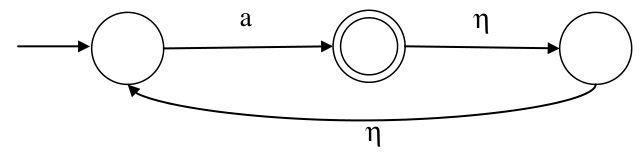
What is the complement of the language accepted by the NFA shown below?
Assume Σ={a}\Sigma = \{a\} and ϵ\epsilon is the empty string.

(In the figure, the edge label printed as η denotes ϵ\epsilon.)
Question figure
Show answer without attempting

Answer: B

Q24

GATE CS 2012 CSComputabilityMCQ1 mark−1/3 if wrong
Which of the following problems are decidable?

1) Does a given program ever produce an output?
2) If LL is a context-free language, then, is L‾\overline{L} also context-free?
3) If LL is a regular language, then, is L‾\overline{L} also regular?
4) If LL is a recursive language, then, is L‾\overline{L} also recursive?
Show answer without attempting

Answer: D

0/200 correct0 marks

Related topics in GATE CS