Theory of Computation questions

Q4

GATE CS 2012 CSComputabilityMCQ1 mark−1/3 if wrong
Assuming P≠NPP \neq NP, which of the following is TRUE?
Show answer without attempting

Answer: B

Q12

GATE CS 2012 CSRegular LanguagesMCQ1 mark−1/3 if wrong
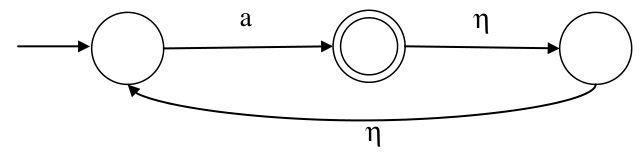
What is the complement of the language accepted by the NFA shown below?
Assume Σ={a}\Sigma = \{a\} and ϵ\epsilon is the empty string.

(In the figure, the edge label printed as η denotes ϵ\epsilon.)
Question figure
Show answer without attempting

Answer: B

Q24

GATE CS 2012 CSComputabilityMCQ1 mark−1/3 if wrong
Which of the following problems are decidable?

1) Does a given program ever produce an output?
2) If LL is a context-free language, then, is L‾\overline{L} also context-free?
3) If LL is a regular language, then, is L‾\overline{L} also regular?
4) If LL is a recursive language, then, is L‾\overline{L} also recursive?
Show answer without attempting

Answer: D

Q25

GATE CS 2012 CSRegular LanguagesMCQ1 mark−1/3 if wrong
Given the language L={ab,aa,baa}L = \{ab, aa, baa\}, which of the following strings are in L∗L^*?

1) abaabaaabaa
2) aaaabaaaa
3) baaaaabaaaab
4) baaaaabaa
Show answer without attempting

Answer: C

Q46

GATE CS 2012 CSRegular LanguagesMCQ2 marks−2/3 if wrong
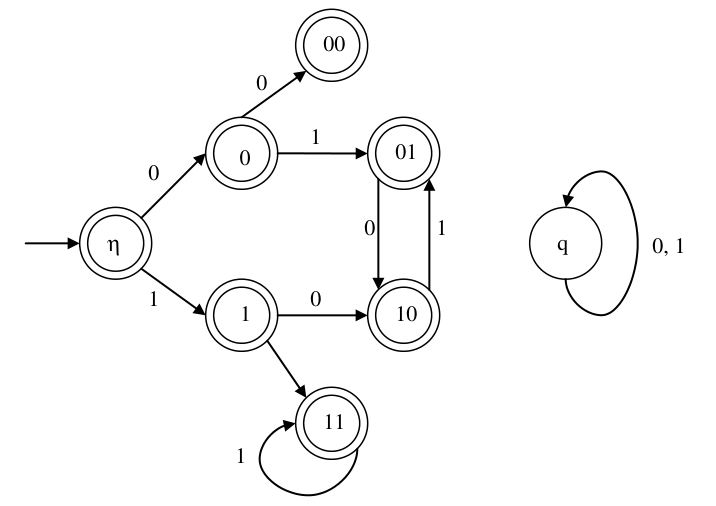
Consider the set of strings on {0,1}\{0,1\} in which, every substring of 3 symbols has at most two zeros. For example, 001110 and 011001 are in the language, but 100010 is not. All strings of length less than 3 are also in the language. A partially completed DFA that accepts this language is shown below.

(In the figure, the start state printed as η is the state for the empty string ϵ\epsilon.)

The missing arcs in the DFA are
Question figure
Show answer without attempting

Answer: D

0/50 correct0 marks

Related topics in GATE CS