Theory of Computation questions

Q8

GATE CS 2013 CSRegular LanguagesMCQ1 mark−1/3 if wrong
Consider the languages L1=ΦL_1 = \Phi and L2={a}L_2 = \{a\}. Which one of the following represents L1L2∗∪L1∗L_1 L_2^* \cup L_1^*?
Show answer without attempting

Answer: A

Q17

GATE CS 2013 CSComputabilityMCQ1 mark−1/3 if wrong
Which of the following statements is/are FALSE?

1. For every non-deterministic Turing machine, there exists an equivalent deterministic Turing machine.
2. Turing recognizable languages are closed under union and complementation.
3. Turing decidable languages are closed under intersection and complementation.
4. Turing recognizable languages are closed under union and intersection.
Show answer without attempting

Answer: C

Q32

GATE CS 2013 CSContext Free LanguagesMCQ2 marks−2/3 if wrong
Consider the following languages.

L1={0p1q0r∣p,q,r≥0}L_1 = \{0^p 1^q 0^r \mid p, q, r \ge 0\}
L2={0p1q0r∣p,q,r≥0,p≠r}L_2 = \{0^p 1^q 0^r \mid p, q, r \ge 0, p \neq r\}

Which one of the following statements is FALSE?
Show answer without attempting

Answer: D

Q33

GATE CS 2013 CSRegular LanguagesMCQ2 marks−2/3 if wrong
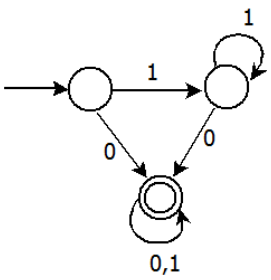
Consider the DFA A given below.

Which of the following are FALSE?

1. Complement of L(A)L(A) is context-free.
2. L(A)=L((11∗0+0)(0+1)∗0∗1∗)L(A) = L((11^*0+0)(0 + 1)^*0^*1^*)
3. For the language accepted by A, A is the minimal DFA.
4. A accepts all strings over {0,1}\{0, 1\} of length at least 2.
Question figure
Show answer without attempting

Answer: D

Q41

GATE CS 2013 CSComputabilityMCQ2 marks−2/3 if wrong
Which of the following is/are undecidable?

1. GG is a CFG. Is L(G)=ΦL(G) = \Phi?
2. GG is a CFG. Is L(G)=Σ∗L(G) = \Sigma^*?
3. MM is a Turing machine. Is L(M)L(M) regular?
4. AA is a DFA and NN is an NFA. Is L(A)=L(N)L(A) = L(N)?
Show answer without attempting

Answer: D

0/50 correct0 marks

Related topics in GATE CS