Computer Networks questions — page 6 of 7

Q34

GATE CS 2015 CS-2Layering and SwitchingNAT1 mark
A link has a transmission speed of 10610^6 bits/sec. It uses data packets of size 1000 bytes each. Assume that the acknowledgment has negligible transmission delay, and that its propagation delay is the same as the data propagation delay. Also assume that the processing delays at nodes are negligible. The efficiency of the stop-and-wait protocol in this setup is exactly 25%. The value of the one-way propagation delay (in milliseconds) is ____________.
Show answer without attempting

Answer: 12
Q35

GATE CS 2015 CS-2Application LayerMCQ1 mark−1/3 if wrong
Which one of the following statements is NOT correct about HTTP cookies?
Show answer without attempting

Answer: A

Q36

GATE CS 2015 CS-2IPv4MCQ2 marks−2/3 if wrong
Consider the following routing table at an IP router:
Network No.Net MaskNext Hop
128.96.170.0255.255.254.0Interface 0
128.96.168.0255.255.254.0Interface 1
128.96.166.0255.255.254.0R2
128.96.164.0255.255.252.0R3
0.0.0.0DefaultR4
For each IP address in Group I identify the correct choice of the next hop from Group II using the entries from the routing table above.

Group I
i) 128.96.171.92
ii) 128.96.167.151
iii) 128.96.163.151
iv) 128.96.165.121

Group II
a) Interface 0
b) Interface 1
c) R2
d) R3
e) R4
Show answer without attempting

Answer: A

Q37

GATE CS 2015 CS-2IPv4MCQ2 marks−2/3 if wrong
Host A sends a UDP datagram containing 8880 bytes of user data to host B over an Ethernet LAN. Ethernet frames may carry data up to 1500 bytes (i.e. MTU=1500 bytes). Size of UDP header is 8 bytes and size of IP header is 20 bytes. There is no option field in IP header. How many total number of IP fragments will be transmitted and what will be the contents of offset field in the last fragment?
Show answer without attempting

Answer: C

Q38

GATE CS 2015 CS-2Transport LayerMCQ2 marks−2/3 if wrong
Assume that the bandwidth for a TCP connection is 1048560 bits/sec. Let α\alpha be the value of RTT in milliseconds (rounded off to the nearest integer) after which the TCP window scale option is needed. Let β\beta be the maximum possible window size with window scale option. Then the values of α\alpha and β\beta are
Show answer without attempting

Answer: C

Q23

GATE CS 2014 CS-2RoutingMCQ1 mark−1/3 if wrong
Which one of the following is TRUE about the interior gateway routing protocols – Routing Information Protocol (RIP) and Open Shortest Path First (OSPF)?
Show answer without attempting

Answer: A

Q24

GATE CS 2014 CS-2Transport LayerMCQ1 mark−1/3 if wrong
Which one of the following socket API functions converts an unconnected active TCP socket into a passive socket?
Show answer without attempting

Answer: C

Q25

GATE CS 2014 CS-2IPv4NAT1 mark
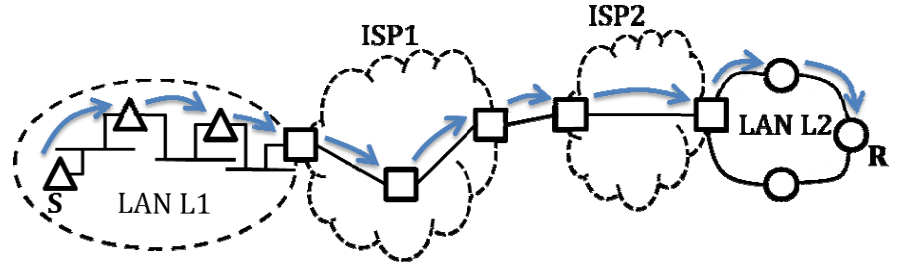
In the diagram shown below, L1 is an Ethernet LAN and L2 is a Token-Ring LAN. An IP packet originates from sender S and traverses to R, as shown. The links within each ISP and across the two ISPs, are all point-to-point optical links. The initial value of the TTL field is 32. The maximum possible value of the TTL field when R receives the datagram is ____________.
Question figure
Show answer without attempting

Answer: 26

Q26

GATE CS 2014 CS-2Layering and SwitchingMCQ2 marks−2/3 if wrong
Consider the store and forward packet switched network given below. Assume that the bandwidth of each link is 10610^6 bytes / sec. A user on host A sends a file of size 10310^3 bytes to host B through routers R1 and R2 in three different ways. In the first case a single packet containing the complete file is transmitted from A to B. In the second case, the file is split into 10 equal parts, and these packets are transmitted from A to B. In the third case, the file is split into 20 equal parts and these packets are sent from A to B. Each packet contains 100 bytes of header information along with the user data. Consider only transmission time and ignore processing, queuing and propagation delays. Also assume that there are no errors during transmission. Let T1, T2 and T3 be the times taken to transmit the file in the first, second and third case respectively. Which one of the following is CORRECT?

A — R1 — R2 — B
Show answer without attempting

Answer: D

Q27

GATE CS 2014 CS-2Layering and SwitchingMCQ2 marks−2/3 if wrong
An IP machine Q has a path to another IP machine H via three IP routers R1, R2, and R3.

Q—R1—R2—R3—H

H acts as an HTTP server, and Q connects to H via HTTP and downloads a file. Session layer encryption is used, with DES as the shared key encryption protocol. Consider the following four pieces of information:

[I1] The URL of the file downloaded by Q
[I2] The TCP port numbers at Q and H
[I3] The IP addresses of Q and H
[I4] The link layer addresses of Q and H

Which of I1, I2, I3, and I4 can an intruder learn through sniffing at R2 alone?
Show answer without attempting

Answer: C

Q28

GATE CS 2014 CS-2Application LayerMCQ2 marks−2/3 if wrong
A graphical HTML browser resident at a network client machine Q accesses a static HTML webpage from a HTTP server S. The static HTML page has exactly one static embedded image which is also at S. Assuming no caching, which one of the following is correct about the HTML webpage loading (including the embedded image)?
Show answer without attempting

Answer: B

Q23

GATE CS 2014 CS-3Layering and SwitchingMCQ1 mark−1/3 if wrong
In the following pairs of OSI protocol layer/sub-layer and its functionality, the INCORRECT pair is
Show answer without attempting

Answer: B

Q24

GATE CS 2014 CS-3Data Link LayerMCQ1 mark−1/3 if wrong
A bit-stuffing based framing protocol uses an 8-bit delimiter pattern of 01111110. If the output bit-string after stuffing is 01111100101, then the input bit-string is
Show answer without attempting

Answer: B

Q25

GATE CS 2014 CS-3IPv4MCQ1 mark−1/3 if wrong
Host A (on TCP/IP v4 network A) sends an IP datagram D to host B (also on TCP/IP v4 network B). Assume that no error occurred during the transmission of D. When D reaches B, which of the following IP header field(s) may be different from that of the original datagram D?

(i) TTL (ii) Checksum (iii) Fragment Offset
Show answer without attempting

Answer: D

Q26

GATE CS 2014 CS-3IPv4NAT2 marks
An IP router implementing Classless Inter-domain Routing (CIDR) receives a packet with address 131.23.151.76. The router’s routing table has the following entries:
PrefixOutput Interface Identifier
131.16.0.0/123
131.28.0.0/145
131.19.0.0/162
131.22.0.0/151
The identifier of the output interface on which this packet will be forwarded is ______.
Show answer without attempting

Answer: 1

Q27

GATE CS 2014 CS-3IPv4NAT2 marks
Every host in an IPv4 network has a 1-second resolution real-time clock with battery backup. Each host needs to generate up to 1000 unique identifiers per second. Assume that each host has a globally unique IPv4 address. Design a 50-bit globally unique ID for this purpose. After what period (in seconds) will the identifiers generated by a host wrap around?
Show answer without attempting

Answer: 256

Q28

GATE CS 2014 CS-3IPv4MCQ2 marks−2/3 if wrong
An IP router with a Maximum Transmission Unit (MTU) of 1500 bytes has received an IP packet of size 4404 bytes with an IP header of length 20 bytes. The values of the relevant fields in the header of the third IP fragment generated by the router for this packet are
Show answer without attempting

Answer: A

Q23

GATE CS 2014 CS-1RoutingMCQ1 mark−1/3 if wrong
Consider the following three statements about link state and distance vector routing protocols, for a large network with 500 network nodes and 4000 links.

[S1] The computational overhead in link state protocols is higher than in distance vector protocols.
[S2] A distance vector protocol (with split horizon) avoids persistent routing loops, but not a link state protocol.
[S3] After a topology change, a link state protocol will converge faster than a distance vector protocol.

Which one of the following is correct about S1, S2, and S3 ?
Show answer without attempting

Answer: D

Q24

GATE CS 2014 CS-1Application LayerMCQ1 mark−1/3 if wrong
Which of the following are used to generate a message digest by the network security protocols?

(P) RSA
(Q) SHA-1
(R) DES
(S) MD5
Show answer without attempting

Answer: C

Q25

GATE CS 2014 CS-1Application LayerMCQ1 mark−1/3 if wrong
Identify the correct order in which the following actions take place in an interaction between a web browser and a web server.

1. The web browser requests a webpage using HTTP.
2. The web browser establishes a TCP connection with the web server.
3. The web server sends the requested webpage using HTTP.
4. The web browser resolves the domain name using DNS.
Show answer without attempting

Answer: A

0/200 correct0 marks

Related topics in GATE CS