Computer Networks questions — page 7 of 7

Q26

GATE CS 2014 CS-1Data Link LayerNAT2 marks
Consider a token ring network with a length of 2 km having 10 stations including a monitoring station. The propagation speed of the signal is 2×1082 \times 10^8 m/s and the token transmission time is ignored. If each station is allowed to hold the token for 2 μsec, the minimum time for which the monitoring station should wait (in μsec) before assuming that the token is lost is _______.
Show answer without attempting

Answer: 28 to 30
Q27

GATE CS 2014 CS-1Transport LayerNAT2 marks
Let the size of congestion window of a TCP connection be 32 KB when a timeout occurs. The round trip time of the connection is 100 msec and the maximum segment size used is 2 KB. The time taken (in msec) by the TCP connection to get back to 32 KB congestion window is _________.
Show answer without attempting

Answer: 1100 to 1300

Q28

GATE CS 2014 CS-1Transport LayerNAT2 marks
Consider a selective repeat sliding window protocol that uses a frame size of 1 KB to send data on a 1.5 Mbps link with a one-way latency of 50 msec. To achieve a link utilization of 60%, the minimum number of bits required to represent the sequence number field is ________.
Show answer without attempting

Answer: 5

Q11

GATE CS 2013 CSApplication LayerMCQ1 mark−1/3 if wrong
Match the problem domains in GROUP I with the solution technologies in GROUP II.
GROUP IGROUP II
(P) Service oriented computing(1) Interoperability
(Q) Heterogeneous communicating systems(2) BPMN
(R) Information representation(3) Publish-find-bind
(S) Process description(4) XML
Show answer without attempting

Answer: C

Q12

GATE CS 2013 CSTransport LayerMCQ1 mark−1/3 if wrong
The transport layer protocols used for real time multimedia, file transfer, DNS and email, respectively are
Show answer without attempting

Answer: C

Q13

GATE CS 2013 CSTransport LayerMCQ1 mark−1/3 if wrong
Using public key cryptography, X adds a digital signature σ\sigma to message MM, encrypts ⟨M,σ⟩\langle M, \sigma \rangle, and sends it to Y, where it is decrypted. Which one of the following sequences of keys is used for the operations?
Show answer without attempting

Answer: D

Q14

GATE CS 2013 CSLayering and SwitchingMCQ1 mark−1/3 if wrong
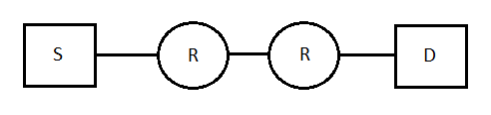
Assume that source S and destination D are connected through two intermediate routers labeled R. Determine how many times each packet has to visit the network layer and the data link layer during a transmission from S to D.
Question figure
Show answer without attempting

Answer: C

Q36

GATE CS 2013 CSData Link LayerMCQ2 marks−2/3 if wrong
Determine the maximum length of the cable (in km) for transmitting data at a rate of 500 Mbps in an Ethernet LAN with frames of size 10,000 bits. Assume the signal speed in the cable to be 2,00,000 km/s.
Show answer without attempting

Answer: B

Q37

GATE CS 2013 CSIPv4MCQ2 marks−2/3 if wrong
In an IPv4 datagram, the M bit is 0, the value of HLEN is 10, the value of total length is 400 and the fragment offset value is 300. The position of the datagram, the sequence numbers of the first and the last bytes of the payload, respectively are
Show answer without attempting

Answer: C

Q38

GATE CS 2013 CSApplication LayerMCQ2 marks−2/3 if wrong
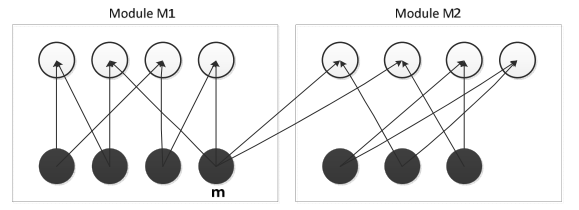
The following figure represents access graphs of two modules M1 and M2. The filled circles represent methods and the unfilled circles represent attributes. If method m is moved to module M2 keeping the attributes where they are, what can we say about the average cohesion and coupling between modules in the system of two modules?
Question figure
Show answer without attempting

Answer: A

Q10

GATE CS 2012 CSApplication LayerMCQ1 mark−1/3 if wrong
The protocol data unit (PDU) for the application layer in the Internet stack is
Show answer without attempting

Answer: C

Q22

GATE CS 2012 CSTransport LayerMCQ1 mark−1/3 if wrong
Which of the following transport layer protocols is used to support electronic mail?
Show answer without attempting

Answer: C

Q23

GATE CS 2012 CSIPv4MCQ1 mark−1/3 if wrong
In the IPv4 addressing format, the number of networks allowed under Class C addresses is
Show answer without attempting

Answer: C

Q34

GATE CS 2012 CSIPv4MCQ2 marks−2/3 if wrong
An Internet Service Provider (ISP) has the following chunk of CIDR-based IP addresses available with it: 245.248.128.0/20. The ISP wants to give half of this chunk of addresses to Organization A, and a quarter to Organization B, while retaining the remaining with itself. Which of the following is a valid allocation of addresses to A and B?
Show answer without attempting

Answer: A

Q44

GATE CS 2012 CSLayering and SwitchingMCQ2 marks−2/3 if wrong
Consider a source computer (S) transmitting a file of size 10610^6 bits to a destination computer (D) over a network of two routers (R1R_1 and R2R_2) and three links (L1L_1, L2L_2, and L3L_3). L1L_1 connects S to R1R_1; L2L_2 connects R1R_1 to R2R_2; and L3L_3 connects R2R_2 to D. Let each link be of length 100 km. Assume signals travel over each link at a speed of 10810^8 meters per second. Assume that the link bandwidth on each link is 1Mbps. Let the file be broken down into 1000 packets each of size 1000 bits. Find the total sum of transmission and propagation delays in transmitting the file from S to D?
Show answer without attempting

Answer: A

Q45

GATE CS 2012 CSTransport LayerMCQ2 marks−2/3 if wrong
Consider an instance of TCP's Additive Increase Multiplicative Decrease (AIMD) algorithm where the window size at the start of the slow start phase is 2 MSS and the threshold at the start of the first transmission is 8 MSS. Assume that a timeout occurs during the fifth transmission. Find the congestion window size at the end of the tenth transmission.
Show answer without attempting

Answer: Marks to all

0/160 correct0 marks

Related topics in GATE CS